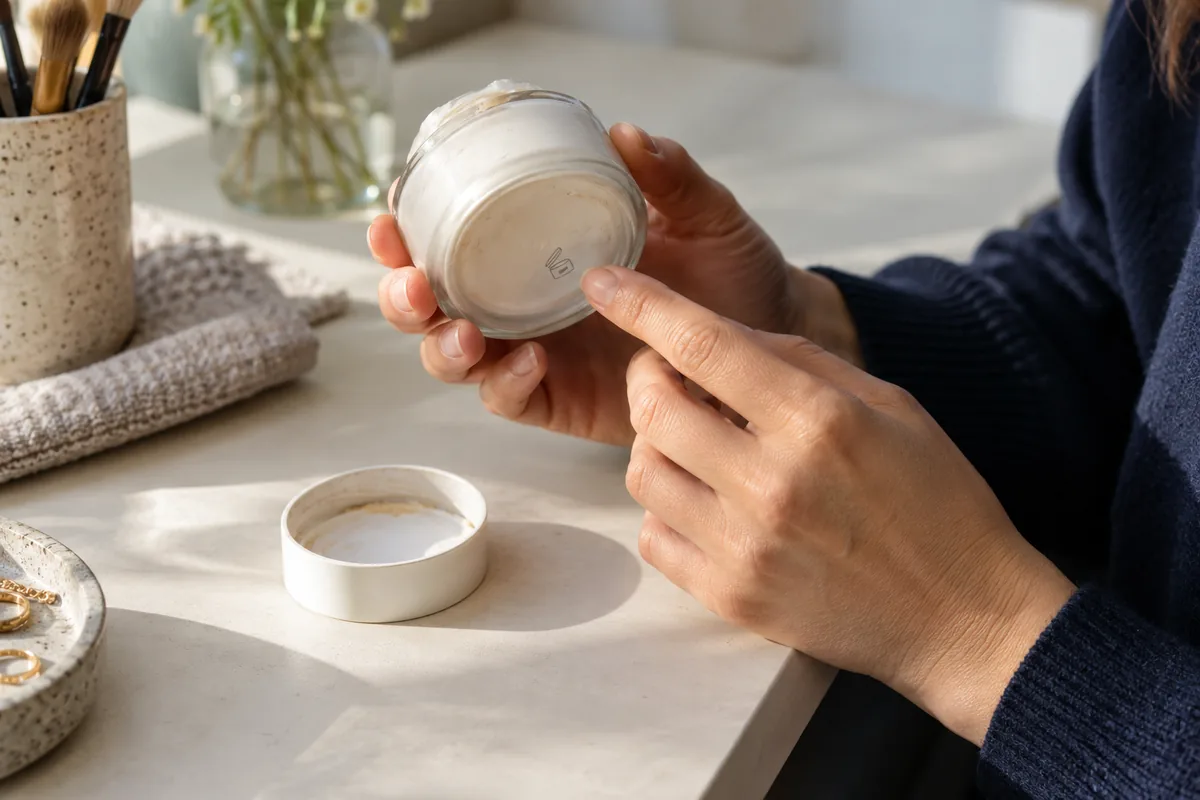
Does skincare actually expire?
Short answer: Yes — most cosmetics don't carry a legally required "best by" date in the U.S., but they do have a real shelf life, and once you open a product, a shorter clock starts running. Look for the small open-jar icon on the back of the packaging (something like "12M"), and watch for changes in color, smell, or texture; together those tell you more than a printed date ever could.
The PAO symbol, and why the U.S. skips it
Under EU law, products generally use the PAO symbol when durability after opening is relevant, while products whose durability after opening is not relevant can fall under an exception. The symbol is separate from the sealed "best by" date [2]. The U.S. has no equivalent: the FDA is direct that no law requires cosmetics to carry specific shelf lives or expiration dates, leaving it to manufacturers as part of their general duty to keep products safe [1]. Drugs are the exception — sunscreen and acne treatment must be tested and dated like any other drug [1].
Why some actives age faster than others
Vitamin C in its most potent form — L-ascorbic acid — is genuinely reactive: unstable in light, and dependent on a formulation pH under about 3.5 to stay stable and absorb well [5]. As it breaks down it oxidizes into a compound that turns the serum yellow, so a deepening amber color is a real sign the antioxidant is fading, not just a cosmetic quirk [5].
Retinoids age on a similar clock. In one pilot study, retinol left exposed to light and open air held onto roughly 91–95% of its potency over four hours, while a cream formulated with antioxidants and sunscreen filters kept total degradation under 10% across a full simulated day of UV and heat — why well-made retinol products ship in opaque tubes or airless pumps, not clear jars [6].
Sunscreen filters fail differently. Avobenzone, a common UVA filter, is photo-unstable — light breaks it into byproducts that absorb UV at shorter wavelengths than the original molecule, so a bottle can look unchanged while its actual protection quietly drops [7]. That's part of why the FDA requires U.S. sunscreens to hold their labeled SPF for three years, and why a bottle that's spent a summer in a hot car is worth tossing early, since heat speeds the same breakdown [4].
Oils have an older problem: they go rancid through oxidation, and the more unsaturated a fat is, the faster that runs [8]. The most polyunsaturated oil in one comparison (grapeseed) broke down fastest, while more saturated oils like peanut and rapeseed held up several times longer — the same chemistry behind an oil serum turning faintly rancid before a more saturated one would [8].
Why storage matters as much as time
Every finger-dip or wand-dip adds bacteria, mold, or yeast that a product's preservatives have to keep in check, and that system weakens with repeated use [1]. Heat and light speed up both preservative breakdown and active-ingredient decay — the FDA specifically warns against a hot car or a steamy bathroom cabinet [1]. Cool, dry, and out of direct light does most of the real work.
Eye products are the sharpest example: manufacturers commonly suggest discarding mascara two to four months after purchase, and some dermatology sources narrow that to three months given the added infection risk [1][3][4]. "All-natural" formulas and anything with non-traditional preservatives (or none) carry extra risk for the same reason — plant-derived ingredients are often more hospitable to microbial growth [3].
Signs it's time to toss a product
Your senses are the best early-warning system:
- A color or texture change that wasn't there before
- A new or "off" smell
- Separation — oil and water pulling apart in a lotion or cream, meaning the emulsion has broken [1].
- A product that's dried out, hardened, or cracked [1].
- Stinging or irritation where the product never bothered you before
Not sure what's actually in something? Running the label through Scan beats guessing.
FAQ
Is it safe to use something past its printed date if it still looks and smells fine?
Often, yes. The FDA calls printed dates "rules of thumb" — badly stored products can go off well before the date, while well-stored ones can stay fine well after it [3]. Be stricter with anything used near the eyes, given the infection risk [3][4].
Does expired sunscreen still protect my skin?
Not reliably. UV filters like avobenzone lose real absorbing power as they photodegrade, and heat — a hot car, a beach bag left in the sun — speeds that up before the printed date [4][7]. The FDA requires U.S. sunscreens to hold their labeled SPF for three years; past that, or after a summer of heat, assume you're not getting the label's protection [4].