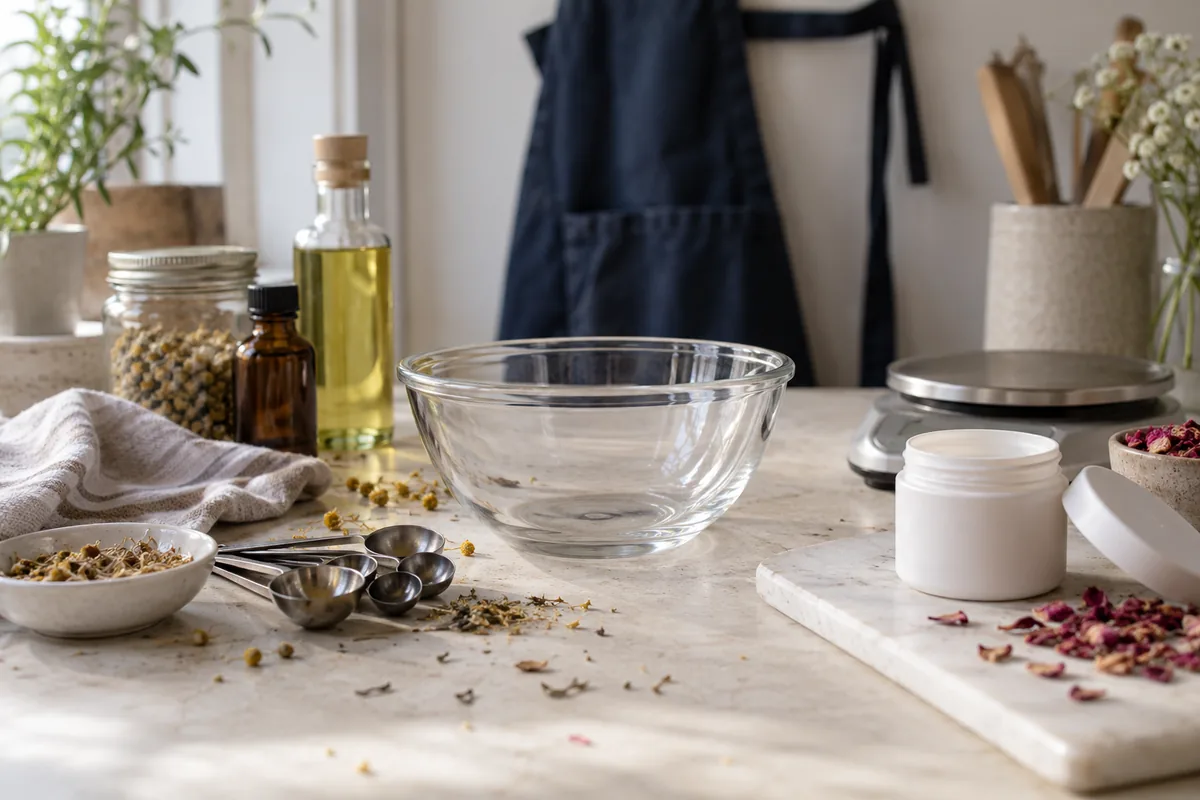
Is DIY skincare actually safe, or should you leave it to store-bought products?
Short answer: evidence for a formulated colloidal-oat product, medical-grade wound honey, or a particular forearm oil study does not make a homemade facial mask low-risk. Some kitchen hacks have caused documented burns and barrier damage: lemon juice in the sun, baking soda scrubs, undiluted essential oils, homemade sunscreen, and toothpaste on pimples.
What's genuinely low-risk to try at home
Plain oats, honey, and simple plant oils have the most evidence behind them.
Finely ground ("colloidal") oatmeal improved measures in a clinical study of a formulated 1% oat cream [7]. That does not establish the safety, dose, preservation, or facial tolerability of a home-blended oat mask.
Honey earns its reputation in a different context: selected medical honey products are used in clinical wound care [8]. That evidence does not establish that ordinary kitchen honey is sterile, preserved, or low-risk as a facial mask, and it should not be treated as an acne treatment.
Plain oils have been studied under specific conditions, but that does not prove a homemade facial mask is low-risk. A controlled forearm study applied olive and sunflower seed oil to adult volunteers for four weeks; sunflower preserved barrier measures while olive oil caused barrier changes and mild redness [9]. "Natural" does not identify the right oil, dose, vehicle, or preservation for facial use.
Where DIY skincare turns genuinely risky
Lemon and other citrus juice. Squeezing lemon onto skin for "brightening" is a persistent DIY myth, and one of the most avoidable injuries. Citrus fruits contain furocoumarins (psoralen compounds) that react with UV light — a well-documented cause of phytophotodermatitis: a painful, sometimes blistering rash in streaks where the juice touched skin, with lingering dark discoloration afterward in many cases [1]. A real vitamin C serum uses a stabilized, pH-formulated form of the ingredient — nothing like raw citric acid.
Baking soda scrubs and masks. Skin's protective "acid mantle" sits in a mildly acidic range, and the enzymes that maintain the barrier work best there; push pH upward and barrier-building slows while water loss and bacterial vulnerability rise [2]. Baking soda is distinctly alkaline — the wrong direction — which is the real chemistry behind why it's a bad scrub ingredient, however satisfying the fizz feels.
Undiluted essential oils. A spilled dose of cinnamon oil left on skin for two hours gave one patient an 8%-body-surface-area chemical burn requiring burn-center treatment; a second documented case involved a burn from a broken vial carried in a pocket [5]. Even diluted, cinnamon and similar oils can trigger allergic reactions — "essential" doesn't mean gentle.
Toothpaste on pimples. Toothpaste is formulated to be abrasive and antibacterial for tooth enamel, not facial skin — ingredients fine on teeth can cause redness, stinging, burning, and irritation on a blemish, often leaving it worse than before [10].
Homemade sunscreen. The highest-stakes hack. Commercial sunscreens go through FDA-mandated testing to verify SPF, water resistance, and shelf life; homemade versions don't, so real protection can't be guaranteed [3]. In one analysis of Pinterest recipes, more than two-thirds recommended formulas with inadequate UV protection even though people confidently posted SPF numbers alongside them [4]. This is the one category where store-bought is worth it every time.
The hidden risk in "natural" recipes: no preservatives
Harmless-sounding DIY ingredients can still turn risky because they lack what every commercial water-based product has: a preservative system. Once a recipe contains water, or gets wet during use, it's a candidate for microbial growth. The FDA is explicit that an ineffective preservation system is one of the most common causes of contaminated cosmetics, and warns against adding water to a product, since that introduces microorganisms and dilutes whatever preservative is there [6]. A jar of homemade toner can look and smell normal while still growing something you can't see — make small batches, refrigerate them, and don't keep one past a few days.
If you already own formulated products and want to know what's in them before you improvise, run the label through our scanner — usually faster, and safer, than reaching for a kitchen ingredient instead.
FAQ
Does lemon juice actually brighten skin, or is that a myth?
Mostly myth, and it can backfire badly. Citric acid alone doesn't reliably lighten skin, and lemon or lime juice exposed to sunlight can trigger phytophotodermatitis — a burn-like reaction, not a glow [1]. A formulated vitamin C product is a tested, completely different thing from raw citrus juice.
Can I make my own sunscreen if I use oils with a high "natural SPF"?
No. Treat any homemade sunscreen recipe as unverified protection, even one citing impressive SPF numbers for individual oils. Most tested Pinterest recipes offered inadequate UV protection despite confident claims [4], and a homemade batch's SPF, water resistance, and shelf life can't be guaranteed the way a commercial product's can [3].
Are oat and honey masks actually backed by evidence, or just a trend?
The cited evidence is narrower than a DIY mask claim: a formulated colloidal-oat cream was studied for eczema [7], and selected medical honey products have been studied in wound care [8]. Neither establishes that a homemade facial mask is low-risk.