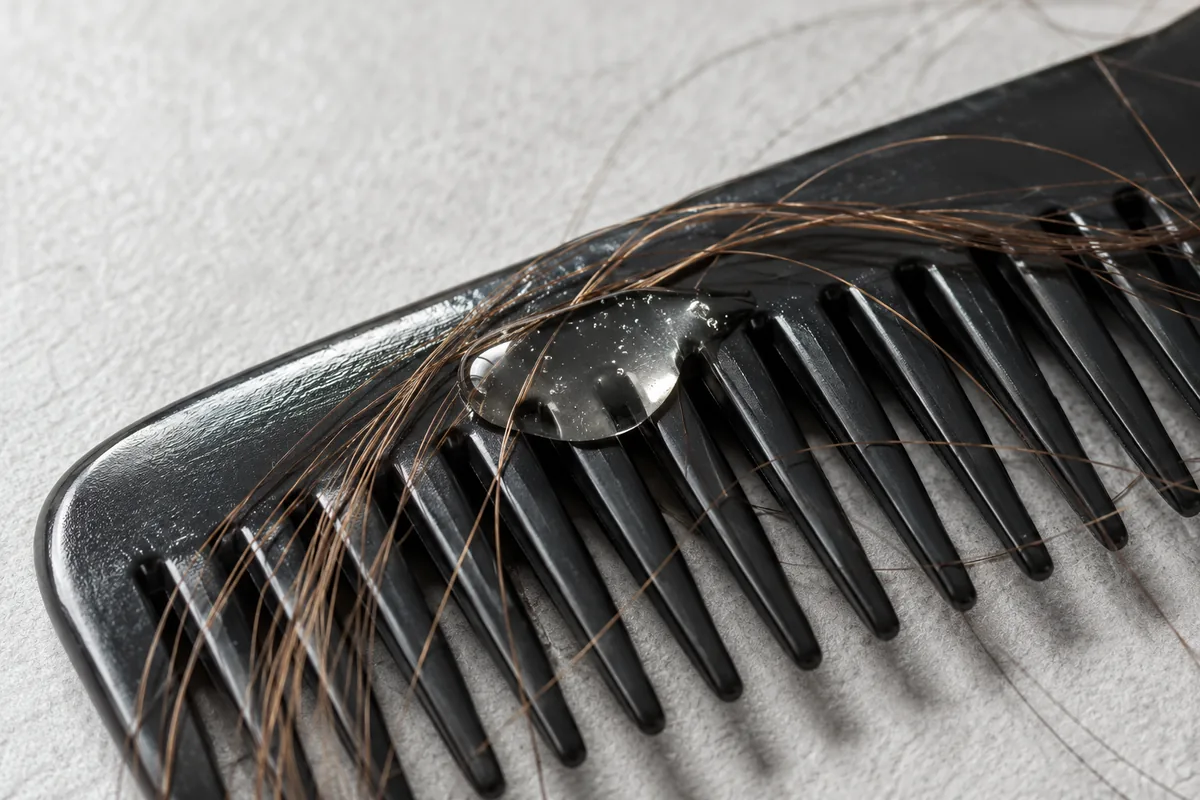
Does silicone in shampoo and conditioner build up and weigh your hair down forever?
Short answer: some silicones can build up a little on hair, but it's a bounded, reversible surface effect, not an endless pileup, and how much you notice it depends on which silicone it is and how healthy your hair's cuticle is.
What silicone is actually doing on your hair
Silicone ingredients coat the hair shaft in a thin, smooth film, filling in rough cuticle spots and cutting friction between strands, which is why silicone conditioners make hair feel instantly softer and shinier [1]. Dimethicone is the most common example: a non-volatile silicone oil that stays on the fiber instead of evaporating, exactly why it's so good at smoothing frizz, and exactly why it's the one people mean when they worry about "buildup."
That word gets used loosely. It doesn't mean silicone is toxic or seals hair shut. It means a coating can thicken over repeated use until hair feels heavier or less responsive to products than usual.
Where the "five washes" internet number actually comes from
A specific figure circulates constantly in hair-care articles: buildup supposedly plateaus after about five washes, and a single silicone-free shampoo strips out the vast majority of it. We traced this back to the 1994 paper usually credited for it, a study on 2-in-1 shampoo technology, to check.
What that paper actually describes is narrower than the popular retelling. It documents how one specific 2-in-1 formula was engineered: charge-neutral dimethicone droplets suspended inside a crystal-like structure that breaks apart during rinsing, depositing the droplets on hair. Its claim is that this design avoids buildup because each wash removes some previously deposited dimethicone along with new soil, not that buildup peaks at a specific wash count or that one wash removes a set percentage [2]. Worth flagging, too: one of its authors was affiliated with a major consumer-products company's hair-care research group, so this reads as industry formulation research describing intended product behavior, not an independent trial across ordinary shampoos [2]. We couldn't verify the "five washes" or "90%" figures against the source, so we aren't repeating them here.
The more modest, better-supported version: water-insoluble silicones like dimethicone genuinely can build up with prolonged use, that part isn't a myth, but a clarifying wash reliably knocks it back down, and overdoing that fix has its own downside of dryness and cuticle roughening [1]. Bounded and manageable, not a runaway pileup.
Why the same shampoo can feel different on two people's hair
Not everyone experiences silicone the same way, and that's not just preference. Hair that's colored, bleached, permed, or heat-damaged carries more negative surface charge than healthy hair, which pulls in more positively charged conditioning ingredients, including some silicones [3]. Certain silicone types are specifically formulated to seek out damaged patches this way, depositing more heavily exactly where hair needs the most smoothing [1]. So damaged or porous hair can genuinely hold more silicone than smooth, healthy hair, and clarify more slowly.
Hair type matters too, independent of damage. Fine, low-density hair has less surface area to spread a heavy silicone film across, so it can look weighed down at a dose a coarser strand wouldn't even register [1]. If you dislike how a silicone-heavy conditioner makes your fine hair sit, that's a legitimate preference, not something you're imagining.
FAQ
Will a clarifying shampoo permanently fix silicone buildup?
It resets the current layer, but if you go back to the same silicone-rich conditioner, some deposit returns over time, it isn't a one-time cure [1]. Most routines do better alternating in a silicone-free or lighter product periodically, rather than reaching for a harsh clarifying wash only once buildup gets bad.
Are silicones bad for my hair, or is this all overblown?
Neither extreme fits the evidence. Water-insoluble types can genuinely build up, so they aren't risk-free in every formula, but the honest read is that silicones remain a reliable, well-studied conditioning ingredient when matched to your hair type and rotated occasionally, not something to fear or avoid outright [1].
How do I know which kind of silicone is in my product?
Check the ingredient list for names ending in "-cone," "-conol," or "-siloxane," dimethicone, cyclopentasiloxane, and amodimethicone are common examples, and each behaves differently on hair. If you'd rather not decode INCI names yourself, you can run a product's label through our ingredient scanner to see what's actually inside.