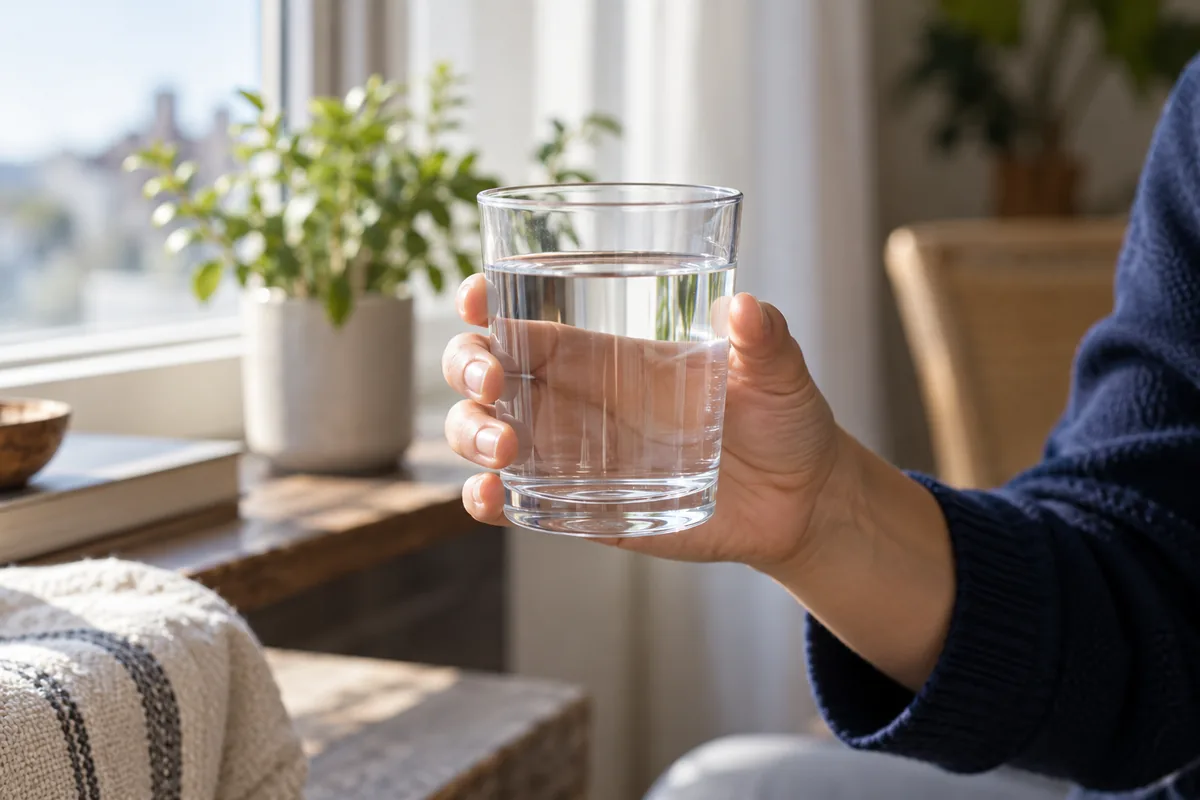
Does drinking more water actually give you glowing skin?
Short answer: the small convenience cohorts available so far show mixed, limited changes. Some people who were under-drinking to start with may show a small hydration bump, but the studies do not support a universal glow effect or a universal no-benefit conclusion.
Where the "8 glasses" rule actually comes from
The number doesn't come from skin science. It traces to a 1945 U.S. Food and Nutrition Board estimate of total daily water needs — which noted, in the very next sentence, that most of that water is already in food and other drinks. That qualifier got dropped over the decades, and "8 glasses" survived as a stand-alone rule later bolted onto skin-care advice.
In 2002, physiologist Heinz Valtin looked for actual evidence behind "8 x 8" and came up empty: no scientific studies supported it, since thirst and the kidneys already keep water balance on track in healthy adults who aren't exercising hard or working in heat [1]. Water still matters — there's just no evidence for a specific universal number, skin or otherwise.
What the water-and-skin studies actually found
A handful of small studies have tested this directly, with mixed results. The most-cited one gave 49 healthy women about 2 liters of extra water a day for 30 days. Among women who'd been drinking less water at baseline, forehead hydration rose from roughly 54 to 76 on the measuring device's scale — a real, significant jump, with a similar rise in deeper-layer hydration. Women who already drank more water going in barely changed, and in neither group did the skin's barrier function (how much water evaporates back out) budge [2].
Zoom out, and it gets more cautious. A 2018 review pooling six studies like this one found a slight hydration increase, mainly in people with lower starting intake — but rated the overall evidence weak, found no proof it changes how skin actually looks, and couldn't explain why the effect happens at all. It's also unclear whether it holds up in older skin [3].
A more direct test came in 2024: 43 women split into water-only, moisturizer-only, both, or neither, for four weeks. Water-only showed no meaningful hydration improvement in this convenience sample, whether women started as low or high water drinkers. Moisturizer did improve things in that study, but this single cohort does not settle every question about water intake and skin [4].
When dehydration really does show up in your skin
The amount matters — normal day-to-day fluctuation isn't it. Clinicians check skin as a dehydration marker using a pinch test called skin turgor: tent the skin up, time how fast it springs back. That test shows something real only at meaningful fluid loss — a slow-to-recover pinch around 5% of body weight lost (mild), poor recovery around 10% (moderate), skin that stays visibly "tented" at 15%+ (severe, needing prompt treatment) [5]. That's dehydration from vomiting, diarrhea, heat illness, or going a long stretch without fluids — not the gap between six glasses and eight.
What actually helps skin hold onto water
If the goal is skin that looks and feels hydrated, the more reliable lever is what you put on it, not what you drink. Humectants are ingredients built to pull water into your skin's outer layer and hold it there, working like the moisture-binding molecules skin already makes [6]. Glycerin is the most common, best-studied humectant in skincare — the workhorse behind a lot of "hydrating" serums and moisturizers.
Humectants alone aren't enough: pulling water in does nothing if it evaporates back out. That's the job of occlusives — ingredients that sit on the surface and slow water loss, often paired with emollients that smooth the skin [6]. A moisturizer combining a humectant with an occlusive does both jobs at once, something a glass of water can't do from the inside.
Not sure what's in your moisturizer, or that "hydrating" toner you rely on? Run the label through our Scan tool to check whether it has real humectants and occlusives, or mostly filler.
FAQ
Is there any harm in drinking more water hoping it'll help my skin?
Drink to thirst rather than forcing down amounts you do not need. The small studies do not establish a universal skin benefit from extra water once someone is adequately hydrated, but they also do not justify a universal no-benefit rule [3].
Does everyday mild under-drinking make skin age faster or look duller over time?
Not well established. The available studies run weeks, not years, and the 2018 review flagged that it's unclear whether even the short-term bump holds up in older skin [3]. Reasonable-sounding, but not something the current evidence backs.
What should I do instead if my skin feels dry or looks dull?
Check your topical routine before your water intake. A humectant like glycerin plus an occlusive or emollient to seal it addresses the actual mechanism [6]. If dryness is new, sudden, or severe, also rule out other causes — weather, over-cleansing, a barrier-damaging active — before blaming water intake.