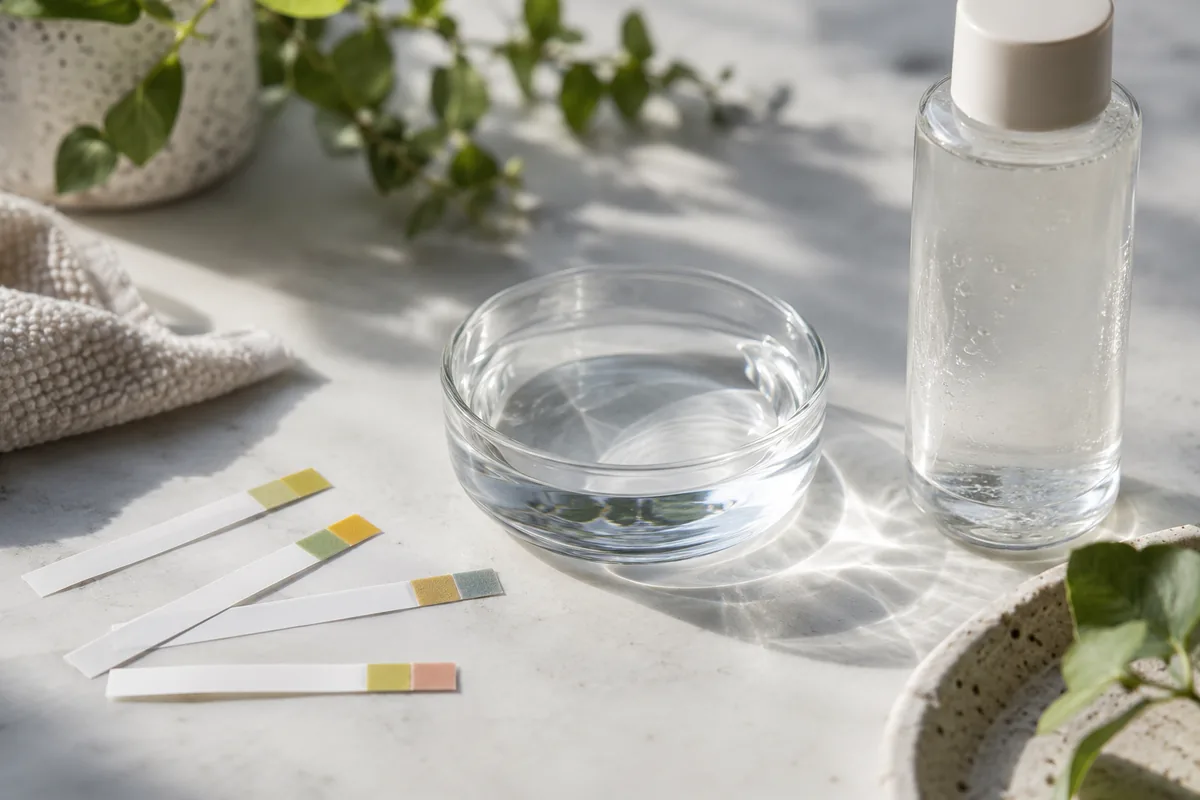
Does skincare pH actually matter, or is it mostly marketing?
Short answer: Yes, in specific ways — skin's natural acidity protects its barrier and microbiome, alkaline bar soap measurably disrupts both, and formulation pH decides how well AHAs and BHAs work. The "wait 30 minutes between products" and DIY pH-strip habits aren't backed by the same evidence.
Your skin's acidic "mantle" runs the show
Your skin sits under a thin, acidic film dermatologists call the acid mantle. In a study where 330 people stopped washing and using skincare for 24 hours, forearm pH settled around 4.9, with the truly undisturbed "natural" value estimated at about 4.7 [1] — well below the neutral 7 most people assume.
That acidity does real work. Ceramides — the lipids holding skin cells together like mortar — are made by enzymes with pH optima around 4.5 and 5.6, squarely in skin's normal range. A separate set of enzymes does the opposite job, breaking the "glue" so old cells shed; that speeds up sharply as pH climbs toward neutral, meaning a too-high surface pH leaves you with both a leakier barrier and uneven shedding [2]. Acidity also helps skin defend itself: each 1-unit drop in pH corresponded to roughly 68% greater die-off of Staphylococcus aureus in one study [4], a bacterium tied to eczema flares — part of why disrupted acid mantle shows up in conditions like eczema [2].
Why bar soap fights your skin and syndets don't
True soap — fats reacted with a strong alkali — typically runs pH 8.5–11. "Syndet" cleansers (synthetic-detergent based, not saponified fat) usually land around pH 5.5–7, much closer to skin's own 4–6 range [3].
That gap matters: harsher bar soap increases water loss and strips more of the stratum corneum's own cholesterol — part of the lipid barrier — than milder syndet bars do, and can raise skin pH by around 3 units for roughly 90 minutes afterward [2][3]. That's real evidence behind "gentle, low-pH" cleanser marketing — but "pH-balanced" on a bottle isn't verified by anyone. The ingredient list is the more reliable tell: true soap shows up as fatty-acid salts like sodium tallowate or potassium cocoate, paired with sodium or potassium hydroxide. Scan can flag those before you buy.
The pH that actually makes AHAs and BHAs work
AHAs and BHAs are weak acids, and formulation pH decides how much sits in its active, skin-penetrating "free acid" form versus its inactive, ionized form.
Glycolic acid, the most common AHA, has a pKa (the pH where it's exactly half free acid) of about 3.83. Over 87% of it sits in the active form at pH 3.0, dropping to 68% at pH 3.5 and under 18% by pH 4.5 — and that active form is also more potent: glycolic acid needed four times less of it to kill acne-related C. acnes at pH 3.0 than at pH 4.0 [5]. Lower formulation pH genuinely means more active ingredient doing more work.
Salicylic acid tells a different story. A tape-stripping study measuring its actual skin-shedding effect found formulation pH barely changed how well it worked, while lower pH significantly increased irritation — chasing "free acid" was, in the authors' words, counterproductive [6]. A low-pH AHA has real chemistry behind it; a BHA marketed as "ultra-low pH for maximum potency" mostly adds irritation risk.
Skin buffers pH fast — so some "rules" don't hold up
Skin actively pulls whatever you put on it back toward its own pH, and quickly: a cream at pH 9 dropped by more than a full unit within 30 minutes on skin, while a cream at pH 4 rose by over half a unit in that window [7]. An in-vitro model found a similar shape — pH knocked down by acid recovered fast, while pH pushed up by alkali took around 30 minutes to approach, but not fully reach, baseline again [8].
That's the real science behind "wait 30 minutes between skincare steps" — and it doesn't support the advice as stated. The buffering happens on skin's own clock, with or without a second product on top, and no trial compares "wait 30 minutes" against "layer right away." A stopwatch doesn't add anything measurable.
FAQ
Do I need to wait 30 minutes between skincare products for pH reasons?
Not based on the pH evidence. Skin's buffering runs on its own timeline whether you wait or not [7][8]. Letting a product sink in first is a fine habit — just don't treat it as a pH requirement.
Can I trust a drugstore pH strip to check my skincare?
A strip tells you a product's pH in the bottle, not whether an acid is actually in its active "free acid" form — that depends on the acid's own pKa, which is why glycolic acid research needed lab ionization measurements, not just a pH reading [5]. It also can't predict how your skin will buffer the product once applied [7][8]. Treat a home reading as a curiosity, not a verdict.
Do "pH-balanced" cleansers actually matter, or is that a label gimmick?
For cleansers, yes — true soap runs alkaline (pH 9–11) and increases water loss and irritation compared with low-pH syndet cleansers closer to skin's own pH [3]. For leave-on products like moisturizers, the stakes are lower, since they aren't rinsed off and skin's own buffering does most of the normalizing work regardless of starting pH [7].