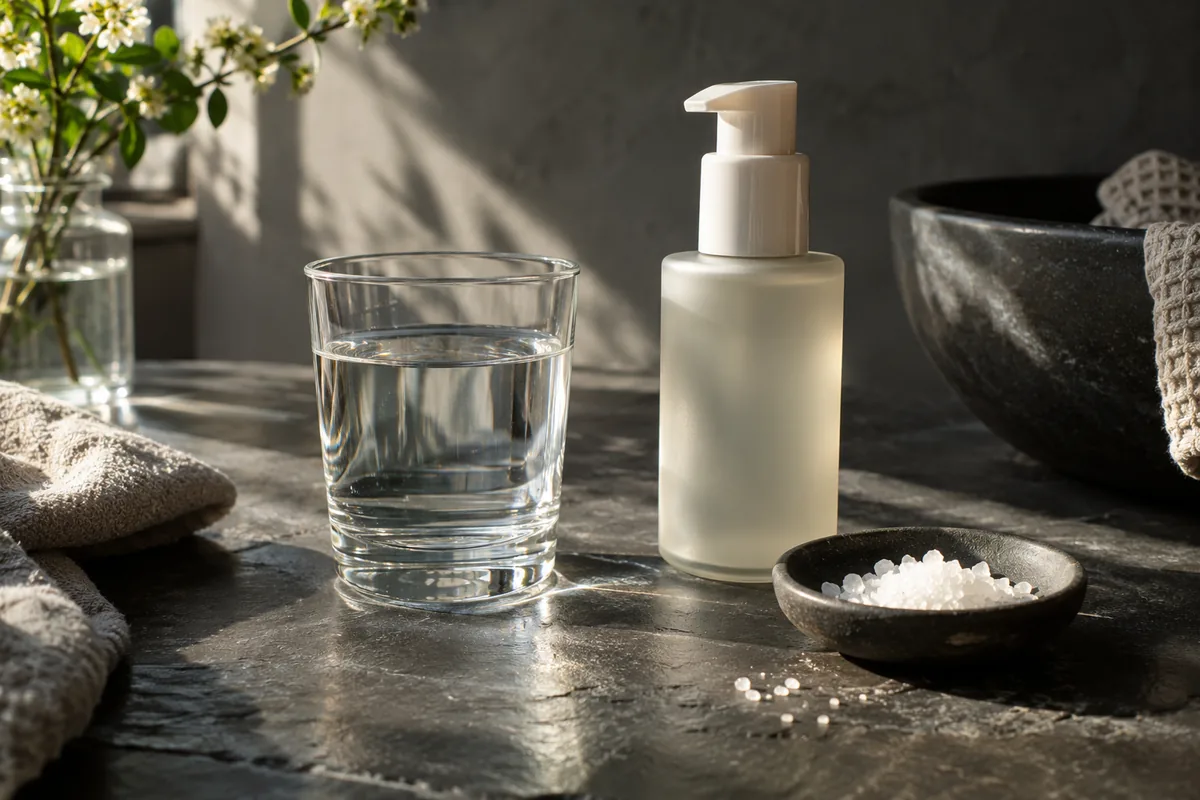
Is "chemical-free skincare" actually a real thing?
Short answer: No. Everything you put on your skin — water, aloe extract, glycerin, a lab-made preservative — is made of chemicals. What actually matters isn't whether something is a chemical, it's whether that specific ingredient, at the dose used, is well-tolerated and well-evidenced.
Why "chemical-free" doesn't mean anything
Every substance with mass — including the water in your cleanser and the aloe in your after-sun gel — is, by definition, a chemical. A nonprofit ingredient-safety research center puts it simply: living things are made of chemicals, and "natural" and lab-made ingredients are all chemicals too — where a chemical comes from doesn't inherently make it better or worse for you [1].
Take glycerin, a common humectant in moisturizers. It behaves identically whether split off from plant oil or synthesized in a reactor — the molecule doesn't care where it came from. Calling a product "chemical-free" because its glycerin came from coconut oil isn't a chemistry claim, since that's scientifically impossible — it's a feeling the brand wants you to have.
The rule that actually matters: dose makes the poison
If "chemical vs. not" is the wrong axis, what's the right one? Toxicology has had an answer since the 1500s. The physician Paracelsus put it this way: "all things are poison, and nothing is without poison; solely the dose determines that a thing is not a poison" [2]. A recent review reframes it for modern testing: there's no such thing as "not toxic" — everything becomes harmful at some concentration and route of exposure, and a "no effect" result often just means the test couldn't detect it at the dose tried, not that no effect exists at any dose [2].
This is why a dermatologist isn't inconsistent saying one low-strength acid formula is tolerable for a particular use while a high-strength peel is supervised. Origin doesn't set the safety bar — pH, vehicle, dose, formulation, and exposure do.
The "chemical sunscreen" scare, and what the FDA actually found
This is where "chemical-free" marketing gets its most convincing fuel: sunscreen. Zinc oxide and titanium dioxide get marketed as "mineral" filters, while avobenzone, oxybenzone, and octocrylene get called "chemical" filters — as if the first group weren't chemicals too (zinc oxide is a manufactured compound like any of the others).
In 2019, an FDA-funded trial tested four sunscreens under maximal-use conditions and tracked participants' blood for a week. All four pushed at least one ingredient's plasma level above 0.5 ng/mL — the threshold that triggers extra toxicology testing — after a single day; avobenzone peaked between roughly 1.8 and 4.3 ng/mL depending on the formula [3]. That threshold is a trigger for additional study, not evidence of toxicity. The study's authors did not say people should stop using sunscreen [3].
That same year, the FDA proposed rules widely misquoted as "the FDA doesn't trust chemical sunscreens." What it actually proposed: zinc oxide and titanium dioxide have enough data to be classified GRASE (Generally Recognized As Safe and Effective) up to 25% concentration, while twelve other ingredients need more data first [4]. The FDA addressed the obvious follow-up directly: this proposal "does not represent a conclusion... that the sunscreen active ingredients proposed as having insufficient data are unsafe" — they're requesting more information, not failing a safety test [4].
None of this changes the FDA's core advice: broad-spectrum sunscreen, SPF 15+, reapplied every two hours, paired with shade and clothing [5]. Whichever filter you'll actually tolerate and reapply is the one that protects you.
How to actually judge whether an ingredient is safe
Drop "chemical vs. natural" as your filter, and ask three better questions instead:
- Has this specific ingredient been studied at the concentration used? A high, chronic sunscreen-level exposure is a different question than a preservative at 0.1% in a rinse-off cleanser.
- Do regulators or dermatology bodies flag a concern? FDA GRASE status and dermatologist guidance exist so you don't have to read every primary study yourself.
- Does your own skin actually tolerate it? Population-level safety data doesn't rule out individual sensitivity. Dermatologists recommend patch-testing new products on a small area, like the inside of your arm, daily for about a week before using them on your face [6].
That third question is the one most people skip, and the one a marketing label can't answer. Instead of a front-of-pack "clean" or "chemical-free" claim, scan the actual ingredient list and check what's really in a product.
FAQ
Does "chemical sunscreen" mean it's dangerous?
No. It means a set of UV filters — avobenzone, oxybenzone, octocrylene, and others — showed measurable blood absorption in a 2019 trial and are still being evaluated for full GRASE status, which the FDA has explicitly said isn't the same as being ruled unsafe [3][4]. Mineral filters already have more complete safety data, which is why they've already been classified GRASE [4]. Either way, the guidance hasn't changed: a broad-spectrum SPF you'll actually wear and reapply protects you far more than one you skip out of fear [5].
Is "natural" skincare always safer than synthetic skincare?
No. Where an ingredient comes from doesn't determine its safety — its structure, concentration, and how it's used do [1][2]. Some of the most allergenic ingredients in skincare, like certain essential oils, are entirely natural, while some of the best-tolerated, like glycerin and many synthetic preservatives, are lab-made. "Natural" describes origin, not risk.