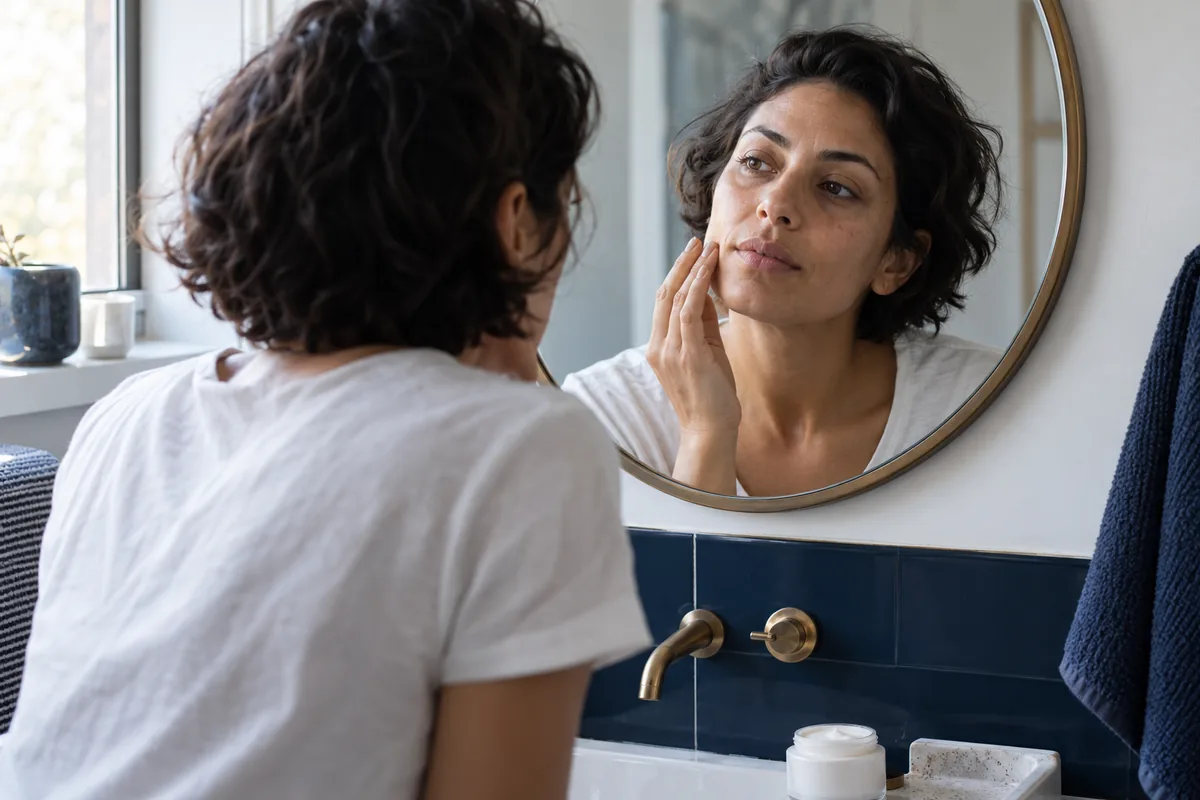
Skincare in your 20s and 30s: what actually matters?
Short answer: daily sunscreen is the highest-leverage habit in both decades — photoaging is cumulative and mostly UV-driven. In your 20s, pair it with gentle cleansing and, optionally, a retinoid. In your 30s, keep sunscreen non-negotiable, add a retinoid if you haven't, and lean into hydration and barrier support. You don't need a 10-step arsenal — consistency on the basics is what the evidence backs.
Your 20s: build the habits, skip the arsenal
If you only do one thing in your 20s, make it sunscreen, every day, rain or shine. This isn't marketing — it's the finding of an actual randomized trial: adults assigned to daily broad-spectrum sunscreen showed 24% less photoaging over 4.5 years than adults who used it only occasionally [1]. A separate study estimated UV exposure accounts for about 80% of visible facial aging — wrinkles, texture, pigmentation — with the rest from intrinsic aging over time [2]. The Academy's baseline recommendation is broad-spectrum, SPF 30 or higher, water-resistant, applied daily [3]. That's the whole spec — you don't need a fancier one.
Second: if you're dealing with acne, be gentle with it. Scrubbing harder or piling on astringents doesn't clear breakouts faster — guidance favors washing gently, up to twice a day, with a non-abrasive cleanser, and skipping products that irritate skin [4]. Some acne treatments also raise sun sensitivity, another reason daily sunscreen belongs in an acne routine. Not sure a product you own fits that profile? Run it through our label scanner first.
A retinoid — like retinal, a vitamin A derivative — is optional in your 20s, but worth starting early if your skin tolerates it: it's the most rigorously studied topical active for fine lines and texture over time [5]. Starting late doesn't cost you ground you can't make up; starting early just means the habit is already built before you need it.
Your 30s: same fundamentals, plus barrier support
Nothing about turning 30 changes the top of the list — sunscreen is still the highest-leverage habit, for the same UV-driven reasons [1][2][3]. If you haven't started a retinoid, your 30s are a reasonable time to start; if you already have, the value is in staying consistent rather than switching products every few months, since improvement builds over 6 to 10 months and resets if you stop [5].
Hydration and barrier support matter more now, too. Avoid over-stripping cleansers, and apply moisturizer right after cleansing or showering so water doesn't evaporate off freshly washed skin. A lighter lotion may be enough for normal skin; dry or barrier-compromised skin does better with a thicker cream [7].
Collagen production does decline with age — research comparing skin from adults in their 20s to adults 80+ found about 68% less ongoing collagen synthesis in the older group [6]. That's real, but it's gradual and cumulative across decades, not a cliff on your 30th birthday — a reason to keep doing what's proven (sunscreen, and a retinoid if you use one), not to panic-buy a shelf of firming serums with far less evidence behind them.
What's actually marketing
Most of what sells a 10-step anti-aging routine — extra serums, ampoules, tools, layered actives — doesn't have anywhere near the trial evidence behind daily sunscreen or a retinoid. That's not to say every other product is useless; it's that the well-supported core is short: SPF 30+ sunscreen every day, a gentle cleanser, a moisturizer suited to your skin type, and, optionally, a retinoid. Everything past that is optimization, not necessity. If a routine starts to feel like a chore, simplify — don't add.
FAQ
Do I need to start a retinoid in my 20s?
No — it's optional. It's the best-evidenced topical active for photoaging, so starting early is a reasonable, low-stakes habit if your skin tolerates it, but there's no evidence that waiting costs you ground you can't make up [5]. Sunscreen is the one habit here that isn't optional.
Is sunscreen worth it if I already have some sun damage?
Yes. The trial behind the 24%-less-photoaging finding didn't require pristine, undamaged skin going in — it measured how much further aging accumulated over 4.5 years based on sunscreen habits [1]. Sunscreen mainly slows future accumulation rather than reversing past damage, but slowing future damage is exactly what makes it worth doing at any age.
Will a retinoid or moisturizer replace the collagen I'm losing?
Not directly. The 68% gap in collagen synthesis was measured between adults in their 20s and adults 80+ — a slow, cumulative decline, not something a single product reverses [6]. Retinoids are separately shown to stimulate collagen synthesis and inhibit some of the enzymes that break it down — part of why they're the best-evidenced anti-aging active available [5] — but support is the honest word here, not reverse.