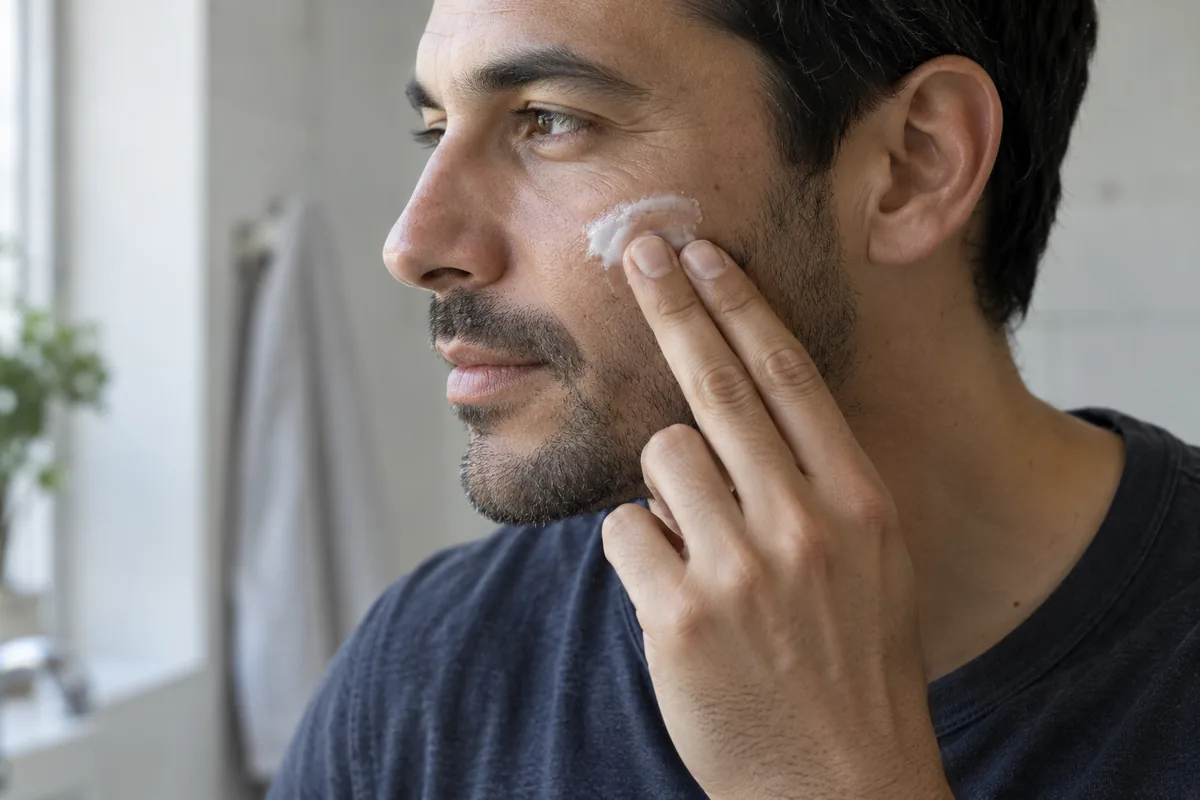
Does men's skin actually need different products?
Short answer: Not really. Male skin runs a bit oilier and thicker on average, but the routine that works is the same one that works for anyone — a gentle cleanser, a moisturizer, daily sunscreen, and optionally a retinoid — chosen for your skin type, not your sex.
What's actually different about male skin — and what isn't
The physiology is real, if modest. A 2018 review pooling dozens of studies on male versus female skin found men tend to have higher sebum production and larger pores, and skin that runs about 10–20% thicker overall, largely from testosterone — with thickness declining steadily from age 20, versus roughly age 50 in women [2]. But the review is upfront this isn't settled science across the board: results were consistent for some measurements and conflicting for others, blamed on differing study design, equipment, and genetics — and it kept just 57 of over a thousand candidate studies, which says something about how much gets filtered for quality [2]. Real average difference, real individual variation — not a clean line that means one gender needs a different product category.
Which is why a dermatologist's practical advice tends to be: worry less about the "for men" label and more about your actual skin type [3]. Dry, sensitive skin needs gentle hydration regardless of sex; oily, acne-prone skin needs oil-free, non-comedogenic products — and the AAD reaches the same conclusion: the basic elements of an effective routine don't change [1].
The actual routine: cleanser, moisturizer, sunscreen, optional retinoid
Four steps cover almost everyone:
- Cleanser. A mild facial cleanser with lukewarm — not hot — water, morning and night. Bar soap and hot water strip skin and can leave it dry or irritated [1][3].
- Moisturizer. Applied to slightly damp skin, it works by trapping water in [1]. Look for a humectant like glycerin, which pulls moisture into skin rather than sitting on top of it — the same ingredient doing the same job whether or not the bottle is marketed to men.
- Sunscreen, every day. The step people skip most, and the one with the clearest evidence behind it. Broad-spectrum SPF 30+, reapplied roughly every two hours or after swimming or sweating [4][5]. The AAD adds a spot people forget: scalp, ears, neck, and lips get plenty of sun and little coverage [1].
- Retinoid (optional). Good for fine lines, uneven texture, or breakouts, but genuinely optional. Start with the lowest strength every other night, apply at night only, and pair it with daytime sunscreen since retinoids raise sun sensitivity [6]. See a dermatologist if your skin gets irritated or concerns go beyond mild [6].
None of this changes if you buy a product marketed to men — the formulation differences are typically cosmetic (scent, packaging), not a different set of actives [1]. If you're unsure what's in something you already own, scan the ingredient list before buying a "for men" version of what's already in your bathroom.
Shaving: where men's routines actually diverge
This is the one place a routine genuinely needs to differ, because shaving is the variable — not skin biology.
Ordinary razor irritation. Shave with the grain, and if ingrown hairs recur, use a gentle exfoliant a couple times a week so hairs grow out normally instead of curling back under the skin [3]. Moisturize afterward and skip alcohol-based aftershaves, which dry out already-stressed skin [3]. If a multi-blade cartridge razor is cutting too close, switching to a single- or double-blade razor — and changing it every five to seven shaves — meaningfully cuts irritation [1].
Pseudofolliculitis barbae (PFB), or true razor bumps, goes a step further: shaved hair curls back and re-enters the skin instead of growing out, causing inflamed, ingrown bumps [7]. Among men of African ancestry, reported prevalence is roughly 45–80%; that is not the share of all PFB cases represented by that group [7]. Prevention is mostly technique: shave with the grain, use sharp blades, don't go over the same spot twice, and leave about a millimeter of stubble instead of chasing an ultra-close shave [7]. Exfoliating acids like glycolic acid help, and switching to an electric shaver sidesteps the problem for people who keep flaring up. Stopping shaving altogether is the safest, most definitive cure [7].
FAQ
Do I really need a separate "men's" moisturizer or cleanser?
No. What matters is matching the product to your skin type — oily, dry, sensitive, acne-prone — not the label's target gender [1][3]. If your skin runs oilier, look for "oil-free" or "non-comedogenic" wording regardless of which aisle it's shelved in [1].
Is it true that men's skin ages differently?
Modestly: men's skin tends to be thicker, and that combined with repeated facial movement tends to produce deeper, more furrowed wrinkles rather than finer lines [2][3]. But the underlying research is inconsistent across a lot of measured traits — a tendency, not a rule for any one person's skin [2].
Should I bother with a retinoid if I'm just starting out?
It's optional. If your basics are solid and you want to address texture or fine lines, a low-strength retinol a few nights a week — always with daytime sunscreen — is a reasonable next step. See a dermatologist first if you have sensitive skin or more significant acne or pigmentation concerns [6].