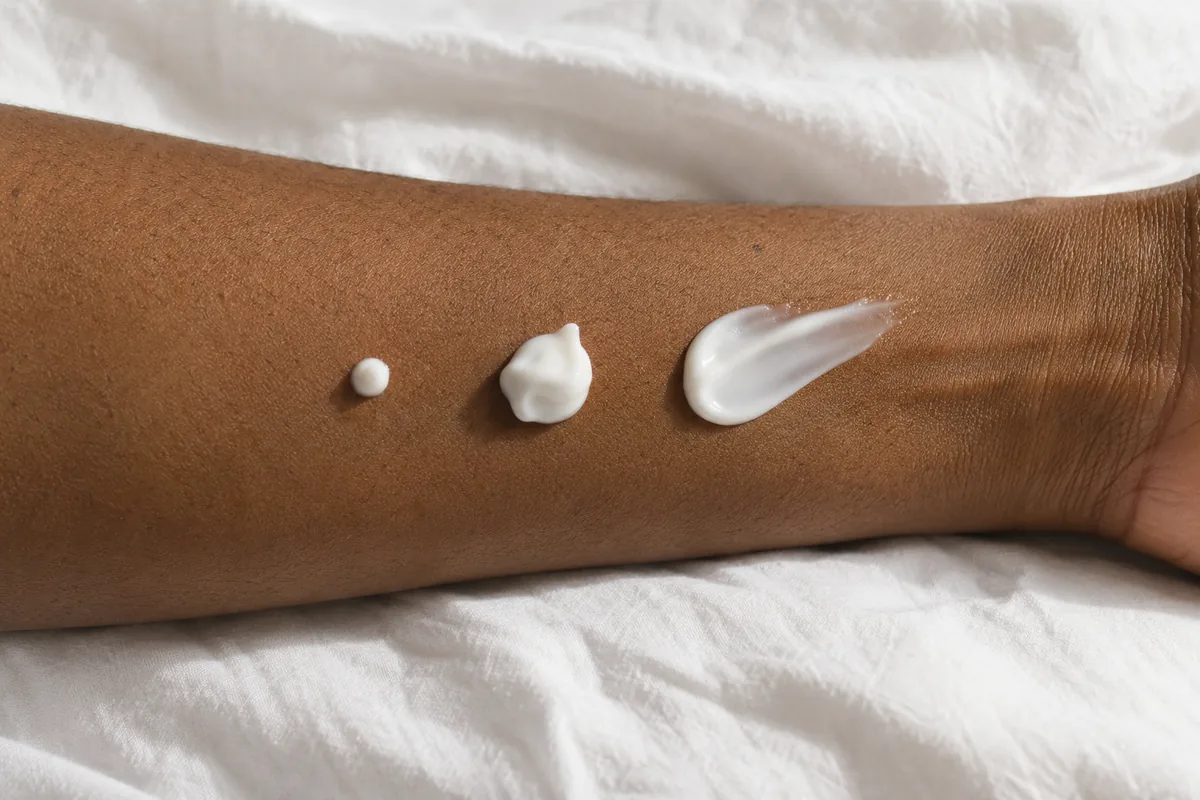
How much skincare product should you actually use?
Short answer: for most steps, the exact amount is forgiving. Sunscreen is the outlier — its SPF number is tested at a specific, generous thickness, and most people apply less than that, so real-world protection usually falls short of the label. For retinoids, the risk runs the other way: more product doesn't work faster, it mostly just irritates.
Why sunscreen is the one where the amount matters
Every SPF number on a bottle comes from a lab test that applies the product at 2 milligrams per square centimeter of skin — a thicker, more deliberate layer than how most people actually rub sunscreen in [1]. The AAD's practical translation of that lab dose is about a teaspoon for your face, plus roughly an ounce — a shot glass' worth — for the rest of your exposed skin, reapplied every two hours outdoors [2]. In practice, most people apply only 25–50% of that amount [9].
That gap matters because protection doesn't fade gently as a layer thins — it drops fast. A study measuring SPF at different application thicknesses on Asian skin found that thinner layers didn't just lower protection proportionally; the relationship curved sharply, to the point that SPF became hard to predict once the layer got down to what people typically apply [3]. A separate study measured the same gap directly in skin instead of on paper, comparing actual UV-related DNA damage at different thicknesses. At the full tested amount, sunscreen significantly cut that damage; at the lower tested thickness, protection was reduced in several measures [4]. It did not establish that most protection universally disappears for every sunscreen or user.
None of this means you need a fancier sunscreen — it means the one you already own works much better with a fuller layer. If you're not sure what's actually in your formula, you can scan the label to see the actives.
For retinoids, more is not better
Retinoids — retinol, retinal, tretinoin, and similar vitamin A derivatives — work on a slow, cumulative timeline, so it's tempting to assume a bigger dab works faster. Standard guidance runs the opposite way: a pea-sized amount is enough to cover your entire face [5]. If you're using something like retinal, the same rule applies.
A study comparing a lower-dose retinol (0.3%) to a higher-dose version (1%) makes the case well. Skin improvement was similar between the two strengths, but tolerance wasn't close. Among 218 participants, 88.7% using the 0.3% formula had no reaction or only a mild one, compared with 62.1% at 1% strength; moderate reactions showed up in just 7.8% of the lower-dose group versus 35% at the higher dose [6]. More product bought a lot more irritation and essentially no extra benefit. That pattern holds more broadly, too — reviews of retinoid formulations describe irritation as dose-dependent, with stronger concentrations causing more of it [7]. Retinoids take weeks to months to show results, so overdoing the amount tends to backfire — the flaking and stinging it causes is usually what makes people quit, which resets the clock instead of speeding it up.
The forgiving middle: cleanser, moisturizer, serum
Not every step has sunscreen's dosing cliff or a retinoid's irritation curve. Dermatology guidance on washing your face is about gentleness, not a measured amount: use a non-abrasive cleanser, apply it with your fingertips rather than a washcloth or sponge, and skip the scrubbing — that's what actually irritates skin, not using a bit less cleanser [8]. Moisturizer works the same way: enough for a light, even layer is the goal. Serums are more concentrated, which is why a few drops is the standard serving size; there's no controlled dosing study for serums the way there is for sunscreen, so the honest guidance is simpler — follow the product's own instructions.
FAQ
Does a higher SPF make up for applying too little sunscreen?
Not reliably. A higher SPF gives you more of a buffer, but protection falls off steeply below the tested 2 mg/cm² thickness, and that drop is hard to predict once you're down at the thickness most people actually use [1][3]. Applying enough product in the first place — about a teaspoon for the face [2] — matters more than chasing a bigger number on the bottle.
Can using too much retinoid make it work faster?
No — if anything it works against you. Retinoid irritation is dose-dependent [7], and a study comparing lower and higher retinol concentrations found comparable skin benefits but substantially more irritation at the higher dose [6]. A pea-sized amount for the whole face is the standard starting point [5]; going heavier mainly raises your odds of the redness and peeling that force you to pause your routine.
How do I know if I'm actually using enough sunscreen?
Use the finger-length benchmark: about a teaspoon for your face, plus roughly an ounce — a shot glass' worth — for the rest of your exposed skin, reapplied every two hours outdoors [2]. If a bottle lasts you much longer than that math implies, you're probably in the 25–50%-of-recommended range most people fall into [9].