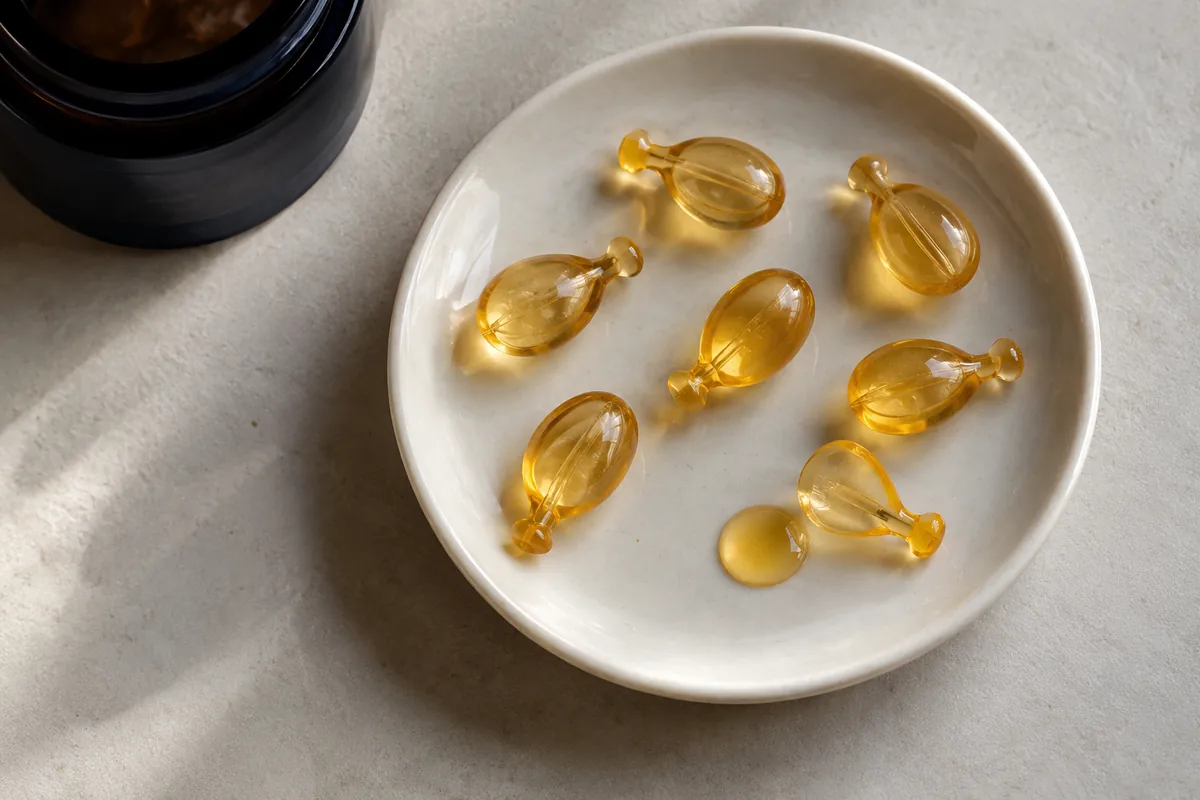
Are Darphin's vitamin C capsules worth it over an affordable vitamin C serum?
Short answer: Darphin's capsules don't use plain L-ascorbic acid - the INCI lists tetrahexyldecyl ascorbate, an oil-soluble vitamin C ester. The clinical evidence for that specific ingredient is thin and comes almost entirely from studies funded by companies with a commercial stake in it. A handful of drugstore-priced L-ascorbic acid serums are cheaper, better-studied, and have live prices right now, while Darphin's own listing doesn't.
What form of vitamin C is actually in Darphin's capsules?
The product's own ingredient list, viewable on its product page, names Tetrahexyldecyl Ascorbate as its second listed ingredient, after Coco-Caprylate (the oil base the capsule liquid is built on). That positioning is reasonably prominent for an oil-format product - but the compound itself is a lipid-soluble vitamin C ester, chemically distinct from the L-ascorbic acid (L-AA) form that most of the clinical vitamin C literature is built around. Darphin's own marketing name for the product, "Pro-Vitamin C," is a fair description of what this actually is: a precursor compound, not the active acid itself.
That distinction matters more than it sounds like it should. As covered in our broader look at the vitamin C evidence, L-AA is the form behind the classic six-month photoaging trial that most "vitamin C smooths skin" claims trace back to - and it's also the form that's fussy: unstable, acidic, prone to oxidizing brown (see our explainer on vitamin C browning). Derivatives like tetrahexyldecyl ascorbate exist specifically to dodge that instability. The tradeoff, as a rule, is that "your skin has to convert them into ascorbic acid, and they generally have less direct proof than plain L-ascorbic acid" - which is exactly the case here.
Does tetrahexyldecyl ascorbate itself have good evidence behind it?
Some, but it comes from a narrow, commercially concentrated set of sources. A search of the primary literature on tetrahexyldecyl ascorbate turns up mostly small studies (35 to 44 participants) run out of the same lab group, Integrative Skin Science and Research in Sacramento. One, an 8-week double-blind trial, was funded by Sytheon Ltd - the manufacturer of both tetrahexyldecyl ascorbate and acetyl zingerone, the ingredient nearly always tested alongside it as a stabilizer [1]. The other, a 12-week open-label study with an overlapping author list, was funded by Image Skincare, a different personal-care brand [2] - not the ingredient's manufacturer this time, but still a company with a commercial stake in a favorable result for its own tested serum. Neither tie is disqualifying on its own - sponsored trials can be real data - but it means this isn't independently repeated evidence; it's the same small research group's output, funded at each turn by a company with a stake in the outcome, and it should be read that way rather than as neutral science.
More striking is what an earlier study from an overlapping author group found about the raw ingredient on its own: in cell and biochemical testing, tetrahexyldecyl ascorbate "degrades rapidly when exposed to singlet oxygen" and behaves as "a poor antioxidant" unless paired with a stabilizing antioxidant - and without that pairing it showed pro-inflammatory effects in the same lab models [3]. This study, too, was funded by Sytheon, with two of its five authors employed directly by the company. That's in-vitro data (cell and biochemical assays, not skin on a person), so it doesn't tell you what happens on your face - but it's a notable admission, from researchers with direct ties to the ingredient's manufacturer, that the unstabilized compound isn't a strong performer by itself. Darphin's capsule formula does pair it with tocopherol (vitamin E) and other antioxidants, which may address some of this - but that combination hasn't itself been through the kind of trial the Sytheon- and Image Skincare-funded studies ran.
What does an L-ascorbic acid alternative actually cost?
Darphin's own product listing carries no live retailer price on this site as of this writing - the only stored links are search redirects to Amazon and Google Shopping, not a priced, in-stock offer. So rather than comparing dollar-for-dollar against this specific product, here's what plain L-ascorbic acid costs elsewhere in the catalog, verified against live, in-stock offers at the time of writing:
- Inkey List Vitamin C Serum - $12.00, in stock. Ascorbic Acid is the second listed ingredient (after a silicone base), placing it near the top of the formula.
- CosRx The Vitamin C 13 Serum - $14.70 at Stylevana (also live at $16.80 via iHerb), in stock. Ascorbic Acid is the second listed ingredient after water, with 3-O-Ethyl Ascorbic Acid - another derivative, but one with its own independent literature - as a secondary form.
- Derma Factory Pure Vitamin C E Ferulic Ampoule - $4.64, in stock. A budget CE-Ferulic-style formula: Ascorbic Acid, Ferulic Acid, and a second derivative (Ethyl Ascorbyl Ether) together, echoing the antioxidant-combination logic (vitamin C + E + ferulic acid) behind the more expensive clinically-tested serums in that category.
None of these three have been through a dedicated randomized trial themselves - that's the honest caveat with almost any specific commercial serum, including Darphin's. What they do have is the active form (L-AA) with the deepest independent evidence base, at a fraction of what Darphin retail pricing historically runs.
So is it worth paying more for the Darphin capsules?
On the evidence available, there's no clinical case that tetrahexyldecyl ascorbate outperforms L-ascorbic acid at typical drugstore concentrations - the opposite argument (derivatives being gentler and easier to stabilize, at the cost of weaker direct proof) is the more defensible one, and it's the same tradeoff true of vitamin C derivatives generally. The single-dose capsule format does solve a real problem - oxidation from repeated jar or dropper exposure - but you can get the same "sealed until use" benefit from any product kept in opaque, air-limiting packaging, which several of the affordable options above use. Given that this product currently has no live price to weigh against that convenience, and its key active's clinical support comes mostly from companies with a stake in the ingredient rather than independent labs, an L-ascorbic acid serum is the more evidence-backed way to spend the money - cheaper, and with the primary literature behind the ingredient itself rather than behind a small cluster of company-funded trials.
FAQ
Is tetrahexyldecyl ascorbate a "bad" ingredient?
No - it's a legitimate, well-formulated way to get an oil-soluble vitamin C precursor into a product without the instability of L-ascorbic acid. The concern here isn't that it's harmful; it's that the clinical evidence specifically for it is thinner and more commercially concentrated than the evidence for plain L-AA, so "Pro-Vitamin C" marketing shouldn't be read as equal or superior proof.
Could the antioxidant blend in Darphin's formula (vitamin E, resveratrol) make up the difference?
Possibly - combining vitamin C forms with vitamin E and other antioxidants is a real strategy with some support elsewhere in the literature, and it's the same logic behind combination serums like the CE Ferulic-style option above. But that specific combination, in this specific formula, hasn't been tested in a published trial, so it's a plausible extrapolation, not a demonstrated result.
Does a higher price ever mean a better vitamin C product?
Not by default. As our broader look at the vitamin C evidence covers, efficacy for L-ascorbic acid tops out around 20% concentration regardless of brand, and derivative-based formulas depend on how well the derivative is stabilized and delivered - neither of which tracks reliably with shelf price. Check the full ingredient list and, if you want to check what's in your own routine, run it through the ingredient scanner.


