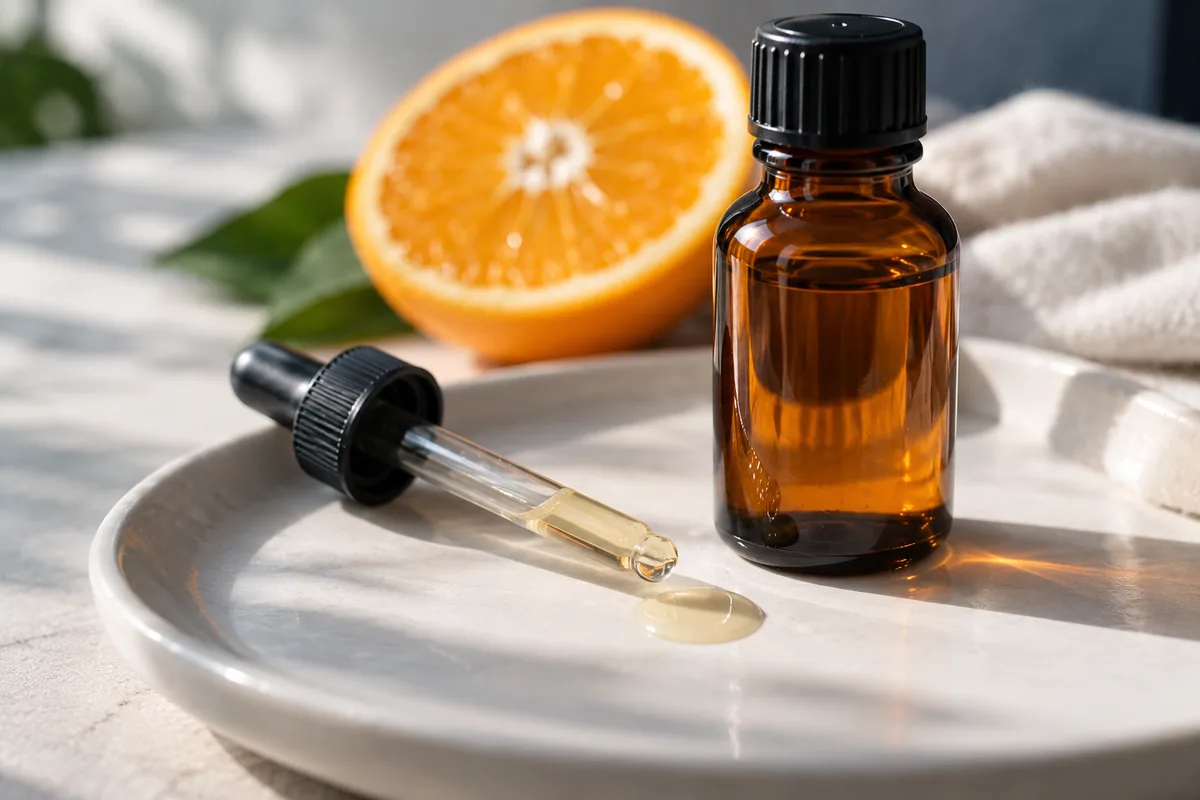
Does vitamin C really do anything for your skin?
Short answer: the right kind, kept fresh, has real evidence for smoother skin — but the chemistry is fussy.
Vitamin C (its skincare name is L-ascorbic acid) is in nearly every "glow" serum. The idea makes sense: it's an antioxidant, meaning it soaks up some of the damaging molecules that sunlight creates in your skin, and your skin also needs it to build collagen (the protein that keeps skin firm).
For the "smoother skin" claim, here's the study, from 2003. Over six months, women applied a 5% vitamin C cream to the photoaged skin on one side (their low neck and forearms) and the same cream without the vitamin C to the matching skin on the other side, double-blind (nobody knew which was which). The vitamin C side showed real improvement in the skin's fine surface texture — dermatologists call it "microrelief" — and a measurable drop in deep furrows. This was double-checked using silicone molds of the skin and small skin samples under a microscope. [1]
The catch is that vitamin C is fussy. Pure L-ascorbic acid falls apart easily:
- It oxidizes — that's why serums turn yellow-brown over time.
- It needs to be quite acidic (a low pH) to sink in, which can sting sensitive skin.
To get around this, brands use gentler, steadier cousins of it — names like sodium ascorbyl phosphate, ascorbyl glucoside, or magnesium ascorbyl phosphate. They're more stable and kinder to skin, but your skin has to convert them into ascorbic acid, and they generally have less direct proof than plain L-ascorbic acid.
What to actually do:
- If you use a pure L-ascorbic acid serum, store it cool and dark, and toss it once it turns brown — oxidized vitamin C isn't doing much.
- Layer it under sunscreen in the morning (antioxidant underneath, UV protection on top).
- More is not better: skin absorption of vitamin C tops out around 20% — higher strengths don't add benefit and can add irritation. [2]
Honest caveat: this is one six-month, half-the-face study — encouraging, not a promise for every formula. In fact, a well-made stable "cousin" can easily beat a high-percentage L-ascorbic acid serum that's already gone brown.