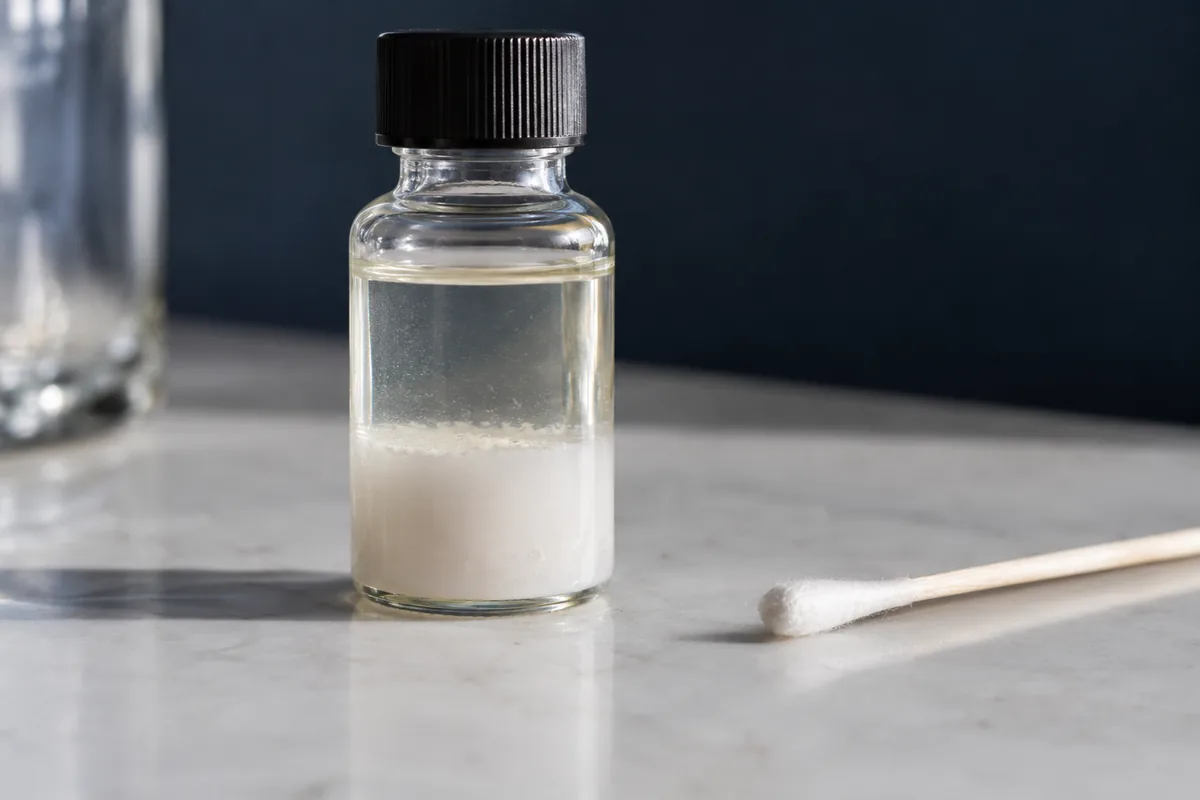
What's actually in Mario Badescu's Buffering Lotion, and is there a cheaper equivalent?
Short answer: it's an isopropyl-alcohol astringent base carrying a niacinamide-and-panthenol finish, with zinc oxide present at a moderate dose and biotin and pyridoxine trailing along at trace levels. The niacinamide is the ingredient with real evidence behind it — see our full niacinamide evidence review. The closest formula match on this site, OHAVE's Concentrated Botanic Biome Cream Night, costs less and shares two of the lotion's more distinctive ingredients — but it isn't a spot-on twin.
What is this product, chemically?
Short answer: an alcohol-based astringent lotion — the category Mario Badescu calls "buffering" — with a small dose of skin-conditioning agents layered on top.
Beautydew's catalog lists the full ingredient panel for the 29 ml bottle as: Isopropyl Alcohol, Propylene Glycol, Zinc Oxide, Hydrolyzed Yeast Protein, Glycerin, Niacinamide, Panthenol, Allantoin, Biotin, Isopropyl Myristate, Stearalkonium Hectorite, Pyridoxine HCl, Propylene Carbonate — decoded from the retailer label via incidecoder.com's public listing, the same method beautydew uses across its catalog. Cosmetic ingredient lists run roughly high-to-low by concentration, so isopropyl alcohol — not niacinamide — is the largest single ingredient by weight. That matters for what the product actually does on skin: alcohol-forward formulas dry down fast and produce a "tightening or tingling" feel, which is literally how the Personal Care Products Council's own ingredient database — cosmeticsinfo.org, funded and maintained by that industry trade group rather than an independent body — classifies isopropyl alcohol's cosmetic function: an astringent, antifoaming agent, solvent, and viscosity-decreasing agent. [1] That's a useful, if industry-sourced, description of mechanism; it isn't a safety or efficacy verdict, and the same source doesn't address how repeated use of an alcohol-forward astringent affects the skin barrier over time, which is a separate, unsettled question this article isn't resolving.
Is the niacinamide in it actually doing anything?
Short answer: possibly, but at a concentration nobody outside Mario Badescu's lab knows — and we've already covered what niacinamide can and can't do elsewhere.
Niacinamide sits fifth on the ingredient list, after the alcohol, propylene glycol, zinc oxide, and hydrolyzed yeast protein — so it's present at a moderate-to-low percentage relative to the base, not headline strength. Beautydew doesn't re-argue the niacinamide evidence base in every article that mentions it; the ingredient has a real clinical trial history for oil control and post-inflammatory marks, covered in detail in our niacinamide evidence review, and the honest caveats there (concentration-dependent, not a universal fix) apply here too. What this product doesn't disclose — and what no public source we could verify discloses — is the actual percentage used, so treat "contains niacinamide" as a directional signal, not a guarantee of the effect size seen in trials that typically test 4–5%.
Is the zinc oxide here doing anti-acne work?
Short answer: probably not much — most of the zinc-and-acne research is about oral or dietary zinc, not a trace topical amount, and it's absent any SPF claim on this product.
Zinc oxide is best known as a physical sunscreen filter, but this lotion carries no SPF claim, so it isn't functioning as UV protection here. According to cosmeticsinfo.org (again, the Personal Care Products Council's own resource, so read its framing as industry-sourced rather than independent), zinc oxide's non-sunscreen cosmetic roles are as a colorant, bulking agent, and OTC skin protectant in products like diaper-rash creams — the source makes no acne, astringent, or anti-inflammatory claim for it. [2] Separately, a 2024 study modeling acne-like inflammation found that high-dose dietary zinc reduced inflammatory markers in zinc-deficient mice — an animal study on oral zinc intake, not a topical formula, and not evidence about this lotion's rubbed-on zinc oxide. [3] Put together: zinc oxide's inclusion here reads more like a legacy "skin protectant" ingredient than a targeted acne treatment with trial support at this dose and route.
What about the biotin, pyridoxine, panthenol, and allantoin?
Short answer: supporting-cast ingredients — panthenol and allantoin are common, well-tolerated conditioning agents; biotin and pyridoxine (vitamin B7 and B6) sit near the bottom of the list, meaning trace amounts.
Panthenol (provitamin B5) and allantoin are two of the most common skin-conditioning agents in the category, used across serums and lotions from drugstore to prestige, generally for a soothing, humectant effect rather than a treatment claim — Beautydew's ingredient page for panthenol covers its individual profile without needing to be repeated here. Biotin and pyridoxine HCl appear last on the list, which under standard cosmetic labeling convention means they're present below 1% — plausible marketing additions rather than active-dose ingredients, and this article isn't independently verifying a topical vitamin-B claim that the brand itself doesn't make on the label.
Is there a genuinely cheaper equivalent?
Short answer: the closest formula match Beautydew's own comparison surfaces is OHAVE's Concentrated Botanic Biome Cream Night — cheaper, but built around a very different ingredient story, not an identical dupe.
Beautydew's dupe comparison for this product ranks candidates by ingredient overlap, and the top match — labeled "best match" on the live page — is OHAVE Concentrated Botanic Biome Cream Night, priced at $12.19 versus £12.24 for the Mario Badescu lotion (both at the time of writing, and in different currencies, so treat this as directionally cheaper rather than a precise like-for-like saving). The overlap that puts OHAVE at the top isn't a coincidence: both formulas share niacinamide, panthenol, stearalkonium hectorite, and propylene carbonate — the latter two are uncommon enough as a pair that their shared presence is a real formulation signal, not just two products both listing niacinamide. That said, "dupe" is doing some work here: OHAVE's formula is a fermented-ingredient-heavy night cream built around hyaluronic acid complexes and multiple ferment extracts that Buffering Lotion doesn't contain at all, and it isn't an alcohol-forward astringent. It's a genuinely related, cheaper product in the same ingredient family — not a swap-in-place clone of an alcohol toner-lotion. Anyone specifically after the astringent, fast-drying feel of the original should expect OHAVE, an emulsion-style night cream, to behave differently on skin even where the actives overlap.
Bottom line
Buffering Lotion is, chemically, an isopropyl-alcohol astringent with a niacinamide-and-panthenol finish, a moderate dose of zinc oxide, and a couple of trace vitamin additions that don't have independent topical evidence behind them at this dose. The one ingredient worth taking seriously on its own evidence is niacinamide, and that evidence lives in our dedicated review rather than here. If price is the driver, OHAVE's Botanic Biome Cream Night is the closest formula match this site's data surfaces and costs less — but it's a different product type, not a drop-in replacement.

![[ideal FOR MEN] Perfect Big Face Mask 23g](https://images.weserv.nl/?url=cdn.shopify.com%2Fs%2Ffiles%2F1%2F0061%2F7516%2F2486%2Ffiles%2Fideal-for-men-perfect-big-face-mask-23g-01-1EA.jpg%3Fv%3D1768182032&w=300&output=webp&q=82&we)

![[VT Cosmetics] Reedle Shot Synergy Repair Cream 50 50ml](https://images.weserv.nl/?url=cdn.shopify.com%2Fs%2Ffiles%2F1%2F0061%2F7516%2F2486%2Ffiles%2Fvt-cosmetics-reedle-shot-synergy-repair-cream-50-50ml-01.jpg%3Fv%3D1781682048&w=300&output=webp&q=82&we)