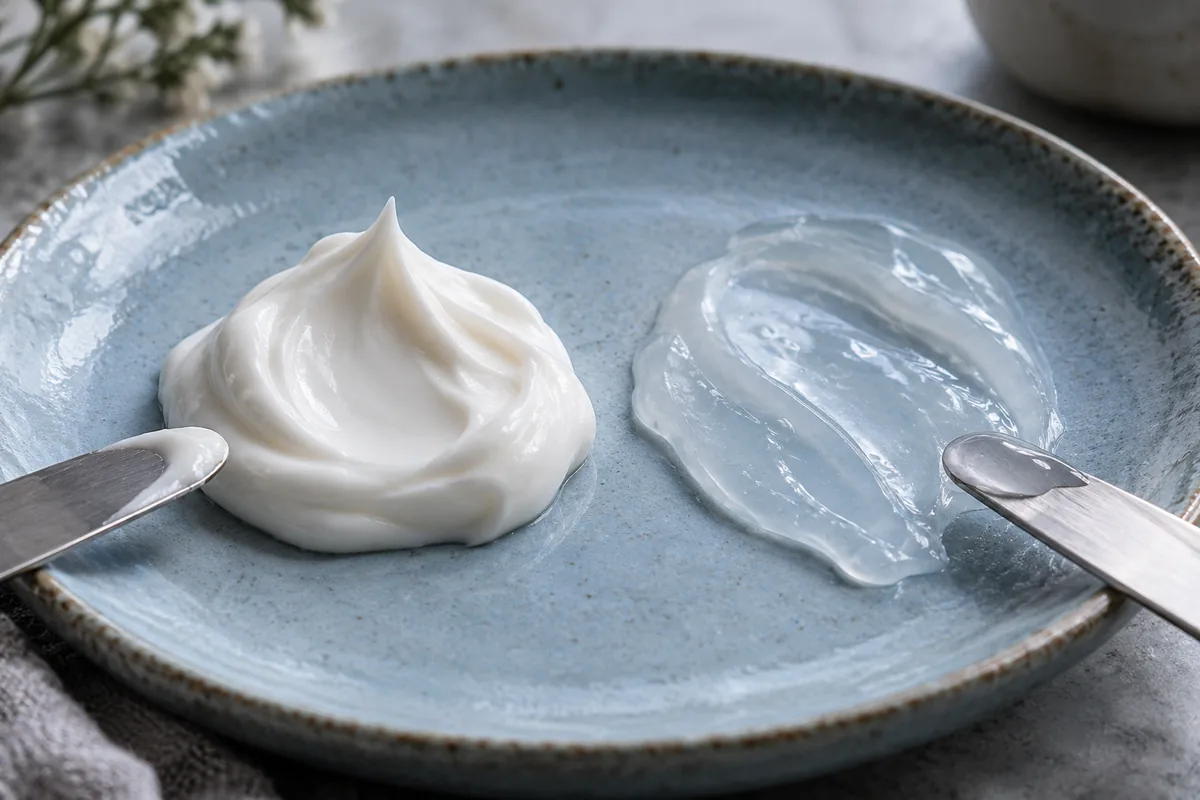
Should you choose BYOMA Moisturising Rich Cream or Gel Cream?
Short answer: Rich Cream is the option to examine if you specifically want shea butter, olive oil or bakuchiol named in the formula; Gel Cream is the option to examine if you want niacinamide or green-tea extract. Both seller pages name Ceramide NP, cholesterol and phytosphingosine. Their shared ingredients do not establish equal concentrations or equal results [1][2].
How we compared the two formulas
Research method: comparison of BYOMA's ingredient decoders, checked on 2026-10-09. We counted each displayed ingredient name once and compared the two lists. The 12 shared names are water, glycerin, Caprylic/Capric Triglyceride, Cetearyl Alcohol, Hydroxyacetophenone, Ceramide NP, cholesterol, phytosphingosine, stearic acid, oleic acid, tromethamine and lactic acid [1][2].
These are BYOMA's own commercial pages. They establish what the seller publishes about these products, not independent evidence of how either cream feels or performs. Both pages identify a 50 ml product. Catalog records and regional packages may differ, so check the declaration on the bottle you intend to buy.
FDA explains the general ingredient-order rules for cosmetics marketed in the United States, including the exception for ingredients present at 1% or less [3]. That does not turn BYOMA's function-grouped web decoder into an ordered package declaration. Neither decoder gives the percentages or molar ratio of its ceramide, cholesterol and fatty acids.
The Rich Cream catalog page and Gel Cream catalog page can help you explore the products. Their stored records are not the source for concentration or position claims in this comparison.
What distinguishes Rich Cream?
Rich Cream's decoder names shea butter, cetearyl olivate, sorbitan olivate, bakuchiol, palmitic acid, olive oil and tocopherol [1]. Those are concrete differences to consider if you are seeking or avoiding one of those ingredients.
Their presence does not establish that Rich Cream is more occlusive, better for dry skin or less suitable for acne-prone skin. We have no comparative finished-product testing here. A known personal reaction is more relevant to your own screening than a generic prediction based on one ingredient.
What distinguishes Gel Cream?
Gel Cream's decoder names niacinamide and green-tea extract and does not display shea butter or olive oil [2]. BYOMA describes it as oil-free and lightweight; those are the seller's positioning claims, not our independent observations.
Its display still includes emollient ingredients such as caprylic/capric triglyceride and pentaerythrityl tetraethylhexanoate, alongside a fatty alcohol and fatty acids [2]. Oil-free does not mean that the formula has no emollients.
How can you make a useful choice?
- Consider Rich Cream when its named shea butter, olive oil or bakuchiol is something you specifically want.
- Consider Gel Cream when niacinamide or green-tea extract is a priority, or when you want to avoid the oils and butter displayed for Rich.
- Treat their shared ceramide/cholesterol/phytosphingosine cluster as a similarity, not proof that their barrier effects are equivalent.
- Check your local package and any ingredients you already know you react to before relying on either web record.
This comparison does not name a performance winner or rank value. It contains no head-to-head trial, personal wear test or dated price comparison.
Related reading
- Which moisturizers list ceramides, cholesterol and fatty acids? shows six examples using a defined ingredient-presence screen.
- Why the three lipid groups are discussed together examines the formulation idea without equating a label mention with an effective ratio.
- Humectants, emollients and occlusives explains different roles within a moisturizer.
- What non-comedogenic means addresses the limits of pore-clogging predictions.
- Use the ingredient scanner to examine the package you have.
FAQ
Does Rich Cream list niacinamide?
It was absent from the Rich Cream decoder checked on 2026-10-09 and present on the Gel Cream decoder [1][2]. That is a statement about those pages, not a guarantee for every past or regional package.
Does Gel Cream contain no emollients?
No. Its seller page includes caprylic/capric triglyceride and pentaerythrityl tetraethylhexanoate even while describing the product as oil-free [2].
Which has the better ceramide ratio?
The sources cannot answer that. Both name ceramide, cholesterol and fatty acids, but do not disclose the amounts or molar ratios needed for that comparison [1][2].

