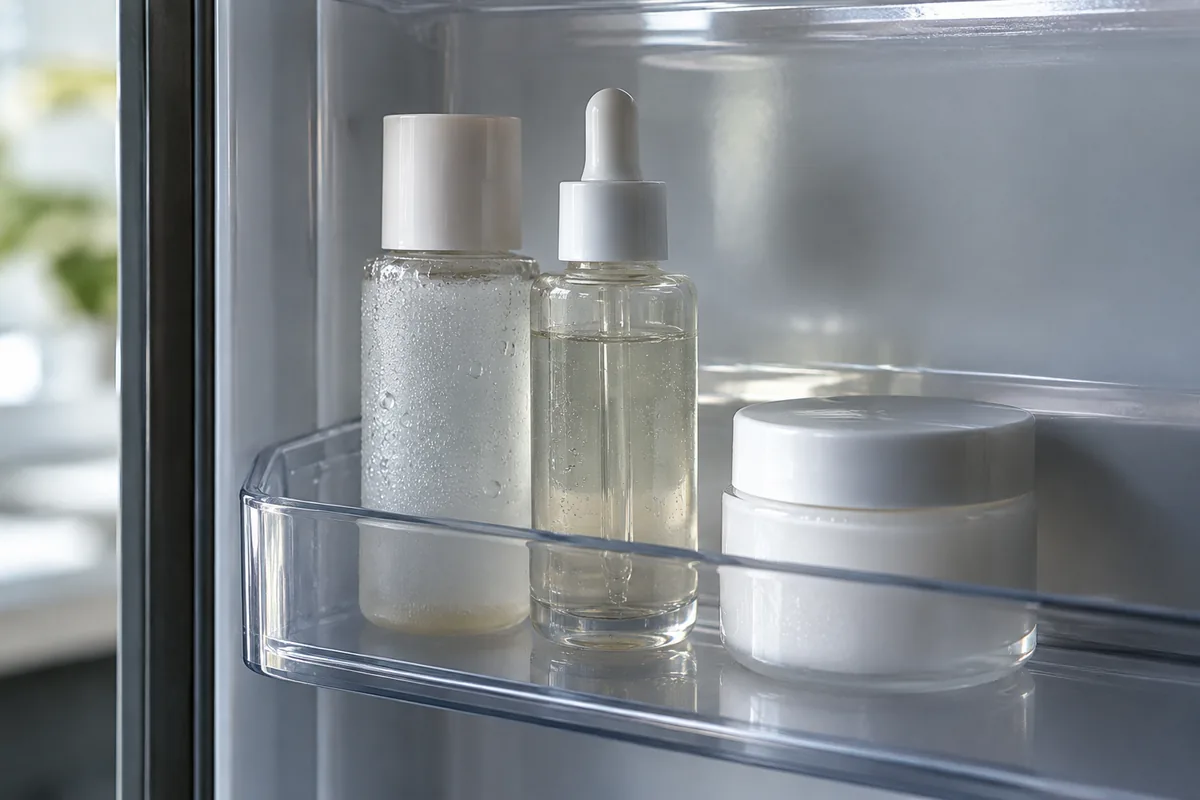
Do you actually need to refrigerate your skincare?
Short answer: almost never, and for most products a skincare fridge is a comfort gadget, not a stability fix — a dermatologist quoted by Cleveland Clinic put it plainly: refrigeration "doesn't change the ingredients of the product" and "doesn't make them more or less effective" for the bulk of a routine. The real exception is chemistry-dependent: L-ascorbic acid (the unstable, well-studied form of vitamin C) oxidizes faster at higher temperatures, so cold measurably slows a reaction that's already happening. Live-culture "probiotic" claims are a different story — the industry's own review literature says the real fix is how the product is formulated (dry, encapsulated, moisture-free), not whether it sits in a fridge.
Which products genuinely benefit from cold?
Vitamin C (L-ascorbic acid) serums are the clearest case, because the chemistry is well characterized. L-ascorbic acid oxidizes on contact with air, light, and heat — the same electron-donating reaction that browns a cut apple — and a lab study that measured ascorbic acid directly in cream formulations (not just by eye) found degradation sped up as pH rose [1]. Oxygen exposure matters more than temperature does day to day: the same study found degradation in the dark ran about seventy times slower than in light, which is why an opaque or airless-pump bottle does more work than a fridge shelf [1]. A separate lab study from Wrocław Medical University and Wrocław University of Science and Technology in Poland — an independent group, publicly funded through a National Science Center grant and a university grant with no industry funding or conflict of interest disclosed — made that point even more starkly, using a different formulation type (topical hydrogels, not a cream): under continuous visible-light exposure at room temperature, unmodified L-ascorbic acid decomposed almost completely within one to two hours in nearly every gel base tested, while the ethylated vitamin C derivative formulated into the same gels lost only about 11–16% of its potency over a full 24 hours [5]. That's a light-stability gap measured in single-digit hours versus a full day, and it holds even with temperature controlled — evidence that a stabilized derivative or an opaque bottle changes vitamin C's fate more than a fridge shelf does on its own. Temperature still moves the needle on its own — a separate analysis of ascorbic acid degradation in food (guava juice, not skin serum, so this is food-matrix chemistry being used as a stand-in for the same underlying reaction) measured 23.4% loss over a week at 25°C (room temperature) versus 56.4% loss at 35°C (a hot bathroom counter or car) [2]. That's the actual mechanism behind "refrigerate your vitamin C serum": you're not making it more potent, you're slowing a decay clock that starts the moment the bottle is opened. For more on why a serum can lose potency before it visibly browns, see our deep dive on vitamin C browning and the ascorbic acid ingredient page.
Live "probiotic" or bacteria-containing formulas are a genuine viability question, but refrigeration isn't the industry's actual answer. A 2021 review on probiotics in cosmetics — coauthored by a microbiologist who separately discloses advising SEED Health, a company that sells its own synbiotic products, a commercial tie worth naming even though it isn't the vitamin-C-adjacent kind [3] — describes storage stability as a genuine, unsolved formulation problem: live strains lose viability with moisture exposure, and the fixes the field actually uses are anhydrous (water-free) bases and microencapsulation, not a cold shelf in your bathroom [3]. A 2026 review from an independent academic group at the University of Valencia's Department of Pharmacy and Pharmaceutical Technology in Spain (no industry funding or conflict of interest disclosed) sharpens why the fridge specifically can't be the fix: under EU cosmetics regulation, any water-containing formulation needs an effective preservative system, and most preservatives that keep a product microbiologically safe from mold and pathogenic bacteria also kill the beneficial live bacteria a "probiotic" claim depends on — a formulation conflict that exists at room temperature, in a fridge, or anywhere else water and preservative are both present [6]. That's the actual reason the field has moved toward carrier systems like alginate microspheres to physically isolate live bacteria from the preservative system, or has sidestepped the viability problem entirely by using postbiotics and paraprobiotics — non-living cell fragments and fermentation metabolites that the same review notes offer "greater stability and safety" precisely because there's no viability clock to protect in the first place [6]. That matters because most "probiotic" skincare on shelves isn't shipped or sold refrigerated in the first place — if a formula depended on a customer's home fridge to keep bacteria alive between purchase and use, it would already be dead well before that, sitting in a warehouse, a delivery truck, or a store shelf at room temperature. A tub that says "probiotic" on the label but was never refrigerated in the supply chain either contains dead bacterial fragments (a legitimate but different claim — often marketed as "postbiotic" fragments or lysates, which don't need to be alive to work) or was formulated specifically to not need cold storage. Refrigerating it at home after that point doesn't retroactively fix anything upstream.
Which products are the marketing theater?
Most of a routine — cleansers, moisturizers, sunscreens, most actives — doesn't chemically need cold storage, and that's the direct claim from Cleveland Clinic's dermatologist source: refrigeration doesn't change what's in the bottle for the majority of formulas built to be shelf-stable at room temperature in the first place [4]. Facial oils are one of the few products Cleveland Clinic flags to keep out of a skin care fridge [4] — cold can make an oil-heavy formula thick and unpleasant to spread until it warms back up, which is a texture problem, not a safety one, but it undercuts the "the fridge preserves it" pitch. The appeal that's real: a chilled toner, eye cream, or gua sha tool feels good on puffy or irritated skin — a genuine sensory and vasoconstriction effect — but that's a use benefit, not a shelf-life benefit, and it applies just as well to a bowl of ice water as it does to a $200 glass-front mini fridge.
So what should you actually put in the fridge?
If you use an L-ascorbic acid vitamin C serum and go through a bottle slowly, cold storage is a reasonable, low-cost hedge — pair it with an opaque or airless container, since keeping it out of light matters more than keeping it cold [1]. Everything else in most routines is formulated to be stable at normal room temperature (roughly 60–80°F / 15–27°C) away from direct sun and a hot windowsill, which is a lower bar than a fridge and one nearly every bathroom already clears. If a bottle looks or smells different than when you bought it, that's a more reliable signal than temperature alone — heat and light both accelerate the same underlying degradation chemistry, they just don't leave a receipt.
FAQ
Does putting my whole routine in a mini fridge make it last longer?
Not meaningfully, for most of a routine. The chemistry driving vitamin C's instability — oxidation from air, light, and heat — is specific to L-ascorbic acid and a handful of other oxidation-prone actives; a stable, well-preserved moisturizer or sunscreen isn't racing against the same clock, so cooling it doesn't slow anything that was going to happen anyway [1][4].
Is a "probiotic" moisturizer actually alive when I use it?
Often not, and that's a formulation choice, not necessarily a flaw — many "biotic" skincare products use dead bacterial fragments or fermentation filtrates (sometimes labeled "postbiotic") specifically because those don't have a viability clock to lose in the first place. Live-culture claims are the harder, less common case, and the formulation literature is explicit that keeping bacteria alive through a real supply chain is still an open problem the industry solves with dry/encapsulated formulas, not refrigeration [3][6].
Will refrigerating a product that doesn't need it hurt it?
Rarely, though extreme cold can make some oil-heavy formulas thick and unpleasant to apply until they warm back up — a texture issue, not a safety one, and one specific counterexample to "when in doubt, chill it" [4].
![[numbuzin] No.9 NAD+ Collagen Under Eye Patch 5EA](https://images.weserv.nl/?url=cdn.shopify.com%2Fs%2Ffiles%2F1%2F0061%2F7516%2F2486%2Ffiles%2Fnumbuzin-no-9-nad-collagen-under-eye-patch-5ea-01.jpg%3Fv%3D1772692584&w=300&output=webp&q=82&we)
![[celimax] The Vita-A Retinal Shot Tightening 2-Step Gel Mask 38g](https://images.weserv.nl/?url=cdn.shopify.com%2Fs%2Ffiles%2F1%2F0061%2F7516%2F2486%2Ffiles%2Fcelimax-the-vita-a-retinal-shot-tightening-2-step-gel-mask-38g-1ea.jpg%3Fv%3D1781508820&w=300&output=webp&q=82&we)
![[Arocell] Mela TXA Sun Serum SPF 50+ PA++++ 40ml](https://images.weserv.nl/?url=cdn.shopify.com%2Fs%2Ffiles%2F1%2F0061%2F7516%2F2486%2Ffiles%2Farocell-mela-txa-sun-serum-spf-50-pa-40ml-01.jpg%3Fv%3D1769563152&w=300&output=webp&q=82&we)