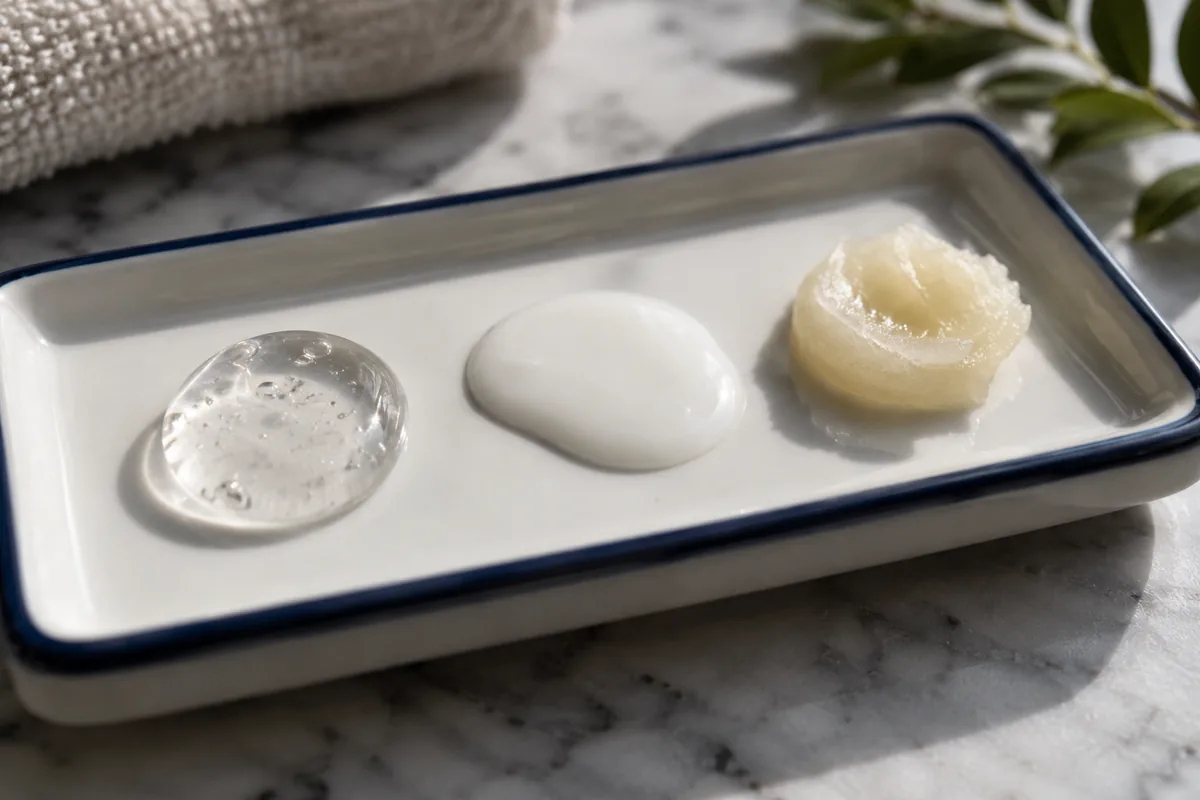
What's actually different between a "hydrating" serum and a "sealing" night cream?
Short answer: they're usually doing different jobs. A moisturizer's ingredients typically fall into three mechanisms — humectants pull water into skin, emollients smooth the surface between skin cells, and occlusives form a film that slows water loss — and the best-performing formulas combine at least two of the three.
Humectants: ingredients that pull water in
Glycerin is one of the most studied humectants; your skin already makes some of its own, moved in part through aquaporin-3, a water channel in skin cells. Applied topically, it measurably improves stratum corneum hydration, barrier function, and skin's mechanical properties, especially in dry, cold conditions [4]. Hyaluronic acid works the same way but holds far more water per molecule once it's in place; a marked drop in epidermal hyaluronic acid is one of the clearer signs of skin aging, and tracks with skin holding less moisture overall [5]. Urea does double duty: at the low concentrations in most daily moisturizers (roughly 2–10%) it behaves as a humectant, but push it much higher (30%+) and it instead breaks down the bonds holding skin cells together — why high-urea creams treat thick, scaly patches, not everyday skin [6].
The catch: on their own, in dry air, humectants can pull water from your own dermis toward the surface, where it evaporates — leaving skin drier than before you started. That's why they're usually formulated alongside an occlusive rather than sold alone [1].
Emollients: ingredients that smooth
Emollients aren't adding water — they're fixing texture. Skin sheds cells unevenly, leaving microscopic gaps and rough edges; emollients fill those gaps, which is what registers under your fingertips as "smooth" [3]. Squalane is a good example: it is the hydrogenated, stabilized form of squalene. Squalene, not hydrogenated squalane, is the lipid that makes up roughly 13% of your skin's natural sebum; the two should not be treated as interchangeable in a sebum claim [7]. Squalane can feel light and smooth, but tolerability still depends on the finished formula and the individual. Fatty alcohols and esters like isopropyl myristate do the same job with different textures and different odds of feeling heavy.
Occlusives: ingredients that seal water in
Occlusives are the most literal of the three: rather than changing anything inside the skin, they sit on top of it and physically block water from evaporating [1]. Petrolatum is the benchmark every other occlusive gets measured against — at as little as 5% concentration, it can reduce water loss through skin by more than 98% [1]. Dimethicone and other silicones work on the same principle but tend to feel lighter and more breathable than a dense petrolatum balm.
Combining them, and picking for your skin
None of the three mechanisms substitutes for the other two, which is why the best-performing moisturizers are usually combinations rather than a single "hero" ingredient. A humectant with no occlusive can leave dry skin drier in a dry room; an occlusive with no humectant just traps whatever water happened to already be there — which is why they're frequently paired [1].
Skin type changes the ratio, not the underlying logic:
- Oily or acne-prone skin generally does better with a lighter, humectant-forward gel or lotion and little heavy occlusive.
- Dry skin does better with a richer cream or ointment base — mostly occlusive plus humectant working together.
- Normal skin can often get by with a lighter lotion, though richer, cream-based formulas matter more as skin ages [8].
If you're not sure what's actually in the moisturizer in your bathroom — humectant-heavy, occlusive-heavy, or some mix — reading the ingredient list beats reading the marketing copy on the jar. Run any product's label through our scan tool to see what's actually listed, in plain language.
FAQ
Is hyaluronic acid better than glycerin for dry skin?
Not clearly, no. They're both humectants doing the same job, and there's no strong head-to-head trial evidence showing one beats the other. Glycerin measurably improves stratum corneum hydration [4]; hyaluronic acid's natural decline tracks with the moisture loss seen in aging skin [5]. In practice many moisturizers include both, and the bigger factor for dry skin is usually whether the product also has an occlusive, not which humectant it uses [1].
Can squalane alone replace my whole moisturizer?
For mildly dry skin, often yes — squalane mimics your own sebum and is well tolerated across skin types [7]. But it's an emollient, not a humectant or occlusive: it doesn't pull in new water or form the sealing film petrolatum does. If your skin or the air is quite dry, pair it with a humectant instead of using it alone.
If I live somewhere humid, do I still need an occlusive?
Less urgently, but often still yes. Humectants pull water from humid air more effectively than dry air, so in genuinely humid conditions they can do more of the job alone [2]. But indoor air conditioning, a damaged barrier, or skin that's already quite dry can still lose water fast — and occlusives help regardless of outside humidity, since they work by blocking evaporation, not depending on it [1].