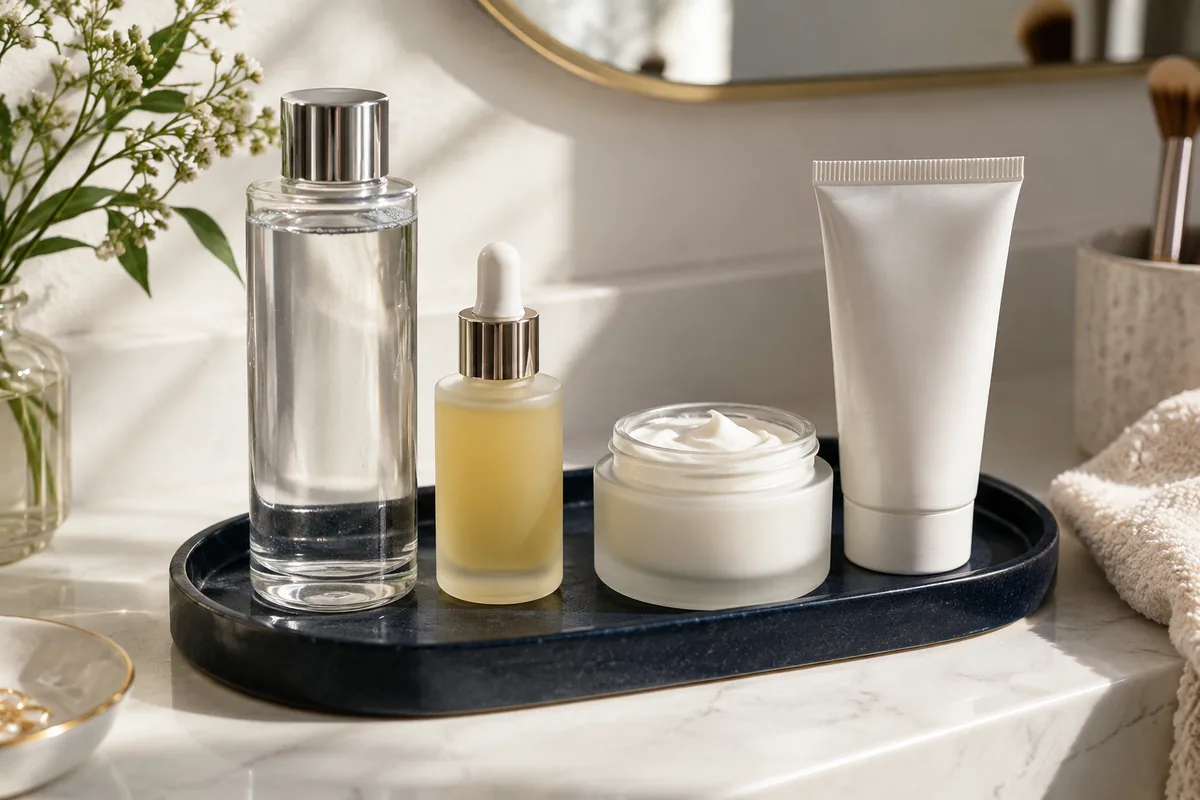
What order should you apply skincare products in?
Short answer: Cleanser first, then anything thin and water-based (toner, essence, serum), then anything thicker (moisturizer, oil), with sunscreen always last in the morning, applied generously. Past that, the "correct" order is mostly common sense, not a stack of clinical trials.
The rule, and why it's common sense more than proven protocol
Cleveland Clinic's standard guidance is lightest to heaviest: cleanser, then thinner treatment products, then moisturizer, then — in the morning — sunscreen [1]. The logic is simple formulation physics: an oil-rich cream sits on skin the way oil sits on water, so applying it first can block a thinner serum from reaching the skin. That's a real mechanism, not a body of head-to-head trials — swap two water-based steps by accident and you're unlikely to notice. Order matters most at the extremes: don't put a heavy occlusive (cream, facial oil, petrolatum) before a serum you want absorbed, and don't skip or bury your sunscreen.
Sunscreen: the step that's actually been measured
Sunscreen is tested in the lab at 2.0 mg/cm² of skin. A study on Asian skin testing fractions of that amount found the relationship between amount applied and SPF delivered isn't a straight line — closer to exponential [3]. Using half the tested amount doesn't cost half your protection; it costs a lot more. That's consistent with the American Academy of Dermatology's guidance: at least one teaspoon for your face, and about an ounce — a shot glass — for the rest of your exposed skin, reapplied every two hours or right after swimming or sweating [2].
Coverage is also patchier than people realize. A study that photographed faces under UV light found an average of 11.1% of the face left uncovered — rising to 16.6% with an SPF moisturizer instead of a dedicated sunscreen — with the eyelids and inner eye corners missed most often, and most people unaware of it afterward [4].
None of that changes with layering order, except one thing: sunscreen goes on last, because once it dries down it forms a protective film, and anything applied on top of it — or applying it too early — can break up that film [1]. Unsure whether something in your routine is safe to combine with sunscreen or your other actives? /scan reads a label and flags what it finds.
The pH myth — and what actually splits AM from PM
A lot of layering advice says to wait 20–30 minutes after vitamin C so the "pH can rebalance." The mechanism is real, but the advice misapplies it. L-ascorbic acid — the well-studied, active form of vitamin C — only crosses into skin well when it's uncharged, which requires the product to be formulated below roughly pH 3.5 [5]. That pH is set by the manufacturer when the product is made, not by anything that happens after you apply it — there's no published protocol behind the "20 minutes" figure. If your vitamin C serum is formulated correctly, layering something on top a minute later doesn't undo what its formulation already did.
What genuinely does split morning from night: retinoids. Topical retinoids (retinol, tretinoin, adapalene) raise skin's sensitivity to sunlight — DermNet lists photosensitivity as a real side effect, and the FDA-approved label for tretinoin warns to minimize sun exposure and use at least SPF 15 while on it [6][7]. That's why they're conventionally used at night, alongside daytime sunscreen. Mornings are where an antioxidant serum earns its place: applying vitamin C with vitamin E gave meaningfully better protection against UV damage than either alone — though that finding comes from an animal-skin (pig) study, a promising mechanism rather than a guarantee it holds identically in human skin [8]. Either way, it's a backup layer under sunscreen, not a replacement for it.
Occlusives belong at the very end for the same reason sunscreen does: applied first, a rich cream or oil can block what comes after; applied last, it locks in what you already put on — which is when ceramide NP is actually doing its job. Want a full AM/PM sequence spelled out product by product? The budget K-beauty routine guide walks through one.
FAQ
Do I really need to wait between skincare steps?
Not for pH reasons — the "wait 20 minutes" vitamin C advice isn't a studied protocol, and the pH that matters is fixed in the formulation, not your skin afterward [5]. A short pause is fine so you're not wiping off the last product, but that's technique, not chemistry.
What's the one layering mistake that actually matters?
Under-applying or skipping sunscreen, or breaking its film with something applied on top. Half the tested amount can cost far more than half the protection, and even careful appliers commonly miss the eyelids and face edges without noticing [3][4]. Getting "generous, last, reapplied" right matters more than any other step's exact order.
Can I use vitamin C and a retinoid in the same routine?
Yes, just not at the same time of day: antioxidants like vitamin C in the morning under sunscreen, retinoids at night, since retinoids call for extra sun caution [6][7]. It's a scheduling choice, not evidence the two are unsafe together.