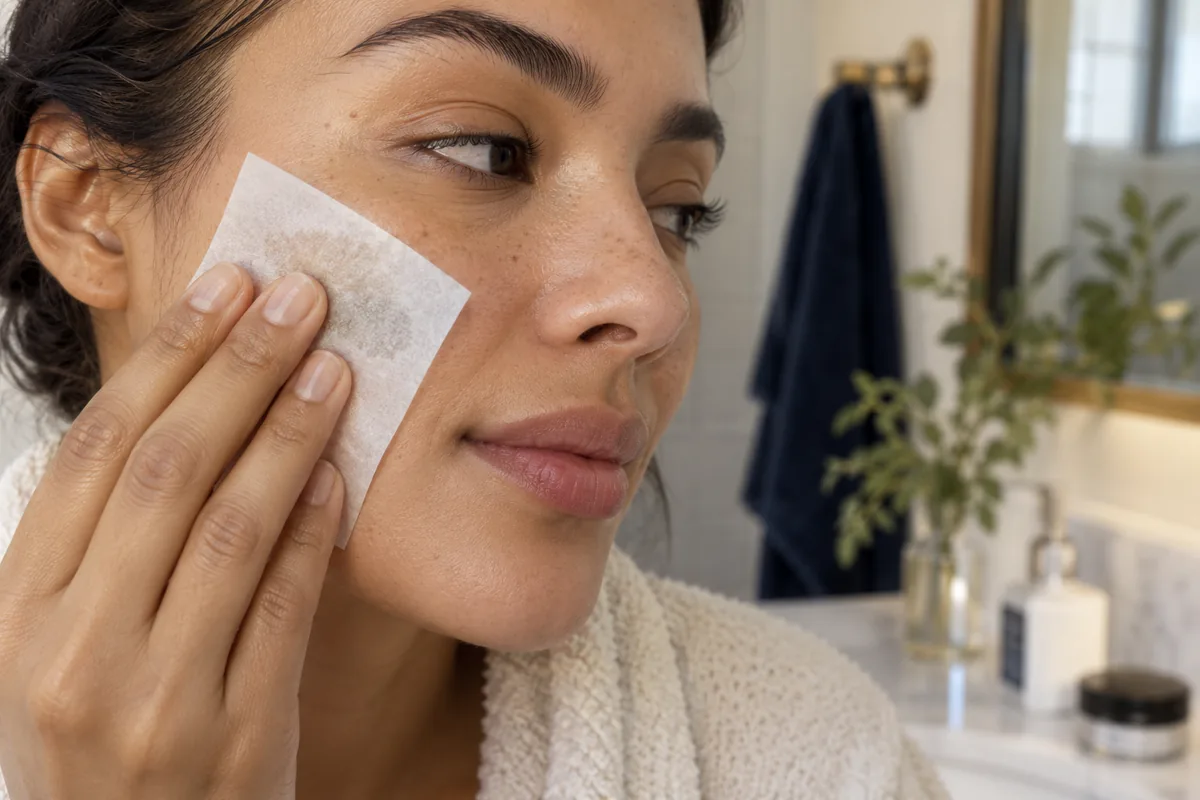
What's my skin type — and does it actually matter?
Short answer: Wash your face, wait 30 minutes with nothing else on it, then check each zone — shiny all over is oily, tight and flaky is dry, an oily T-zone with calmer cheeks is combination, no strong signal is normal. But "sensitive" and "dehydrated" aren't extra types on that list — they're states any skin type can be in, and reacting to them matters more than the label does.
The bare-face test
Wash with a gentle cleanser, pat dry, and put nothing else on — no moisturizer, no serum, no sunscreen. Wait 30 minutes, then check each zone, ideally on an ordinary day rather than right after a workout or a flight [1]:
- Shiny across your forehead, nose, chin, and cheeks: oily.
- Tight, rough, or flaky, especially when you smile or squint: dry.
- Shine only on the forehead/nose/chin, with calmer cheeks: combination.
- No pulling, no shine: normal.
Sebaceous glands — tiny oil-producing glands on your hair follicles — release sebum, a fat mix that lubricates skin and helps the barrier hold together. They're not spread evenly: your forehead can carry 400–900 glands per square centimeter, palms and soles essentially none [2]. More sebum means larger-looking pores and shine; less means a tighter, flakier feel. Neither is a problem on its own — oil helps preserve skin, and oilier skin tends to develop visible fine lines later than drier skin does [7].
Matching a routine to what your skin is doing, not a label, starts with knowing what's in your products — scan a label before adding anything new. Niacinamide is one of the better-studied ingredients for oil control: it lowered sebum output in Japanese participants within weeks, and surface oil in Caucasian participants within six — though a deeper output measure didn't budge for that group, a reminder that actives don't behave identically on every skin [8]. More on the niacinamide page.
"Sensitive" and "dehydrated" are states, not types
Sensitive skin sounds like a type, but it's a reaction pattern: stinging, burning, itching, or tightness triggered by things — water, wind, a new sunscreen — that shouldn't bother normal skin, sometimes with no visible rash [4]. It's shaped by barrier strength, nerve sensitivity, ethnicity, age, and gender — none related to oil output, which is the real difference from "type." It can sit on top of oily, dry, combination, or normal skin alike [4].
"Dry" and "dehydrated" aren't the same axis. Dryness is mainly water loss — from low humidity, indoor heating, age, or certain medical conditions [9] — a somewhat separate system from how much oil your glands put out [2]. That's why oily skin can still feel tight and dull after a long flight: the oil supply hasn't changed, but the water content has. Treating a water problem with oil control, or an oil problem with only humectants, misses the point.
How your type shifts with age, hormones, and season
Skin type isn't a life sentence. Sebum is driven largely by androgens (the hormones that ramp up during puberty): low in infancy, rising through the teens, then gradually declining with age [2]. In women, the decline continues after menopause, alongside growing pore size — hormone therapy blunted the pore-size effect but not the sebum drop [5]. Part of why skin that ran oily at 20 can run drier at 50.
Season moves things faster: sebum, hydration, and pigmentation all rose in summer and fell in winter in a year-long study of 354 women in Shanghai [6], and the T-zone/cheek gap behind combination skin follows the same pattern [3]. Hormonal changes can affect sebum and hydration, but the timing and size of any effect vary; do not use a fixed menstrual-cycle day as a skin-type test [10].
None of this makes skin type unknowable — it means "what's my type" is really asking about a moving average, not a fixed fact. Worth rechecking with the bare-face test if your skin has felt different for a while, rather than holding onto a label from years ago.
FAQ
Do I need to know my exact skin type before choosing a routine?
Not exactly — treating type as gospel can backfire. "Oily" skin that's also dehydrated needs water and barrier support as much as oil control; "dry" skin that develops sensitivity needs a gentler formula, not a heavier cream [9][4]. Notice what your skin is doing this week and adjust, since type drifts with puberty, aging, menopause, and season [2][5][6].
Can I have oily skin and still be dehydrated?
Yes. Oiliness is about sebum output; dehydration is about water content in your outer skin layer, and the two don't move in lockstep [9][2]. A long flight or harsh cleansing can leave oily skin feeling tight and dull even though oil production hasn't changed — oily but dehydrated is a real, common combination, not a contradiction.