Do I actually need to patch test a new skincare product?
Short answer: Yes, for anything you plan to use regularly. Put it on a small, hidden patch of skin twice a day for 7 to 10 days before it goes near your face. It won't catch every possible reaction, but it catches most of the common ones, and it costs nothing.
What patch testing is actually checking for
Two mechanisms cause most reactions to something new on your skin. Irritant contact dermatitis is direct damage, not an immune response — something strips your skin's natural oils and lets more irritant in, hitting fast after one strong exposure or building slowly with repeated use. It's why exfoliating acids and retinoids tend to cause trouble weeks in, not on day one [5]. A week-long test on a leave-on salicylic acid exfoliant only tells you about short-term tolerance, not six weeks of daily use.
Allergic contact dermatitis only shows up once your immune system has become sensitized to an ingredient, and it takes time to build after contact rather than appearing right away — why patch tests, home or clinical, are read over days, not minutes. Either way, testing does the same job: it confines the risk to a coin-sized patch of skin instead of your whole face [1].
How to patch test a new product at home
The American Academy of Dermatology's method works for almost anything new — a serum, a sunscreen, a sheet mask, a cleanser:
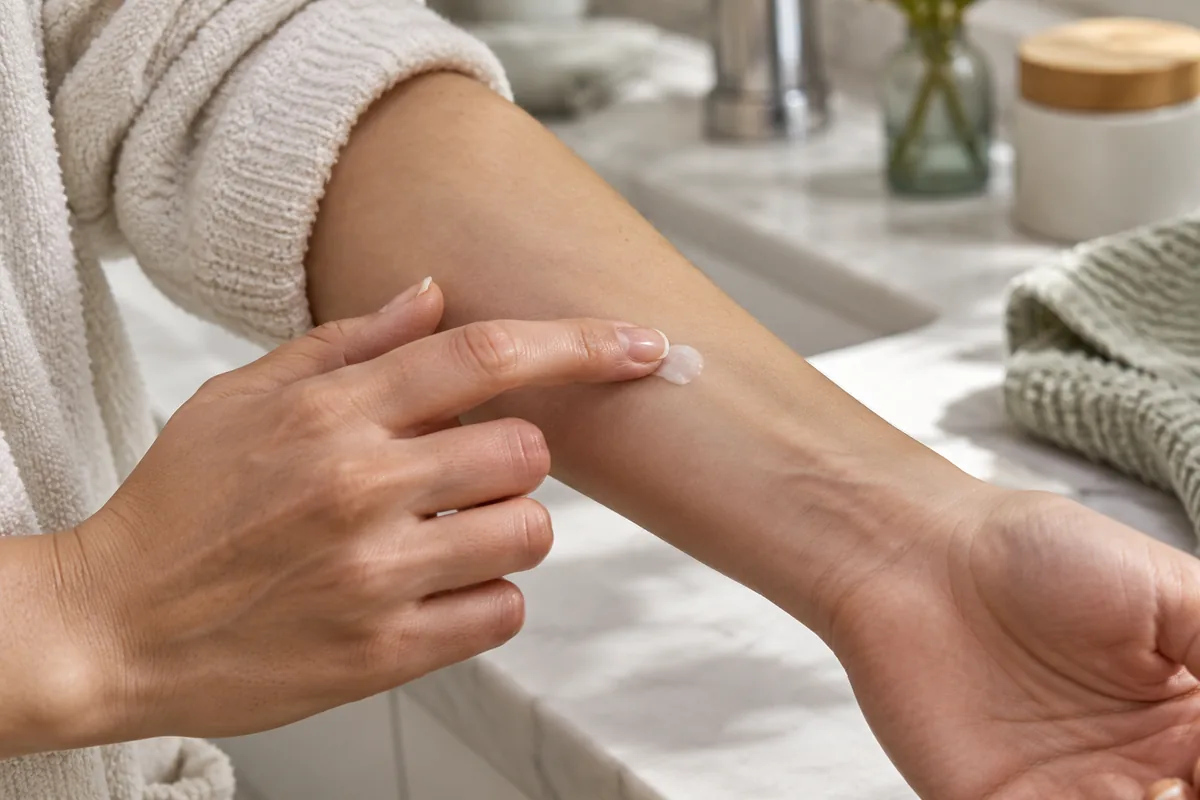
- Pick a spot that won't get rubbed or washed off, like the underside of your arm or the bend of your elbow [3].
- Use it like you normally would — same amount, same thickness. For a rinse-off product like a cleanser, leave it on five minutes before washing it off [3].
- Repeat as directed for the testing period recommended by the product or clinician. A repeated open application test can inform short-term tolerance, but there is no validated day-four or four-week cutoff that diagnoses future facial tolerance.
- Watch for redness, itching, or swelling. If you see any, wash it off right away and don't use it again [3].
- Nothing after 7 to 10 days? Reasonable to start using it — ideally one new product at a time, so a later reaction is easy to trace.
Run the ingredient list through our label scanner first — it won't replace the test, but it tells you what to watch for.
What a clean result doesn't tell you
Timing is the biggest gap. ROAT guidance discusses repeated exposure and variable reaction timing, but it is a consensus method, not outcome evidence for a specific day-four or four-week facial result [6]. Concentration is another limit: people can test positive to an ingredient on a standardized panel, then use the real product without reacting, because the real-world concentration is different [4]. The reverse happens too — a product used for months can still cause a reaction later. Even a full clinical baseline series only catches about 70% of contact dermatitis cases, so one at-home test on one product is narrower still [2]. None of this means testing isn't worth doing; a clean arm is evidence, not a verdict.
When to see a dermatologist instead
If home testing keeps turning up reactions, or you have a recurring rash you can't pin to one product, a formal patch test scales up the same idea: known allergens (10 to 12 per set) taped to your back for 48 hours, then read again roughly 48 hours later, since reactions typically take 48 to 96 hours to show [2]. It's built for allergic reactions specifically, not irritant ones — if your pattern looks more like irritation (worse with frequent use, tied to acids, calmer when you cut back), that's still useful information on its own [2].
Fragrance is the most common thing formal testing turns up, and US labeling rules let dozens of fragrance chemicals hide under the single word "Fragrance," protected as a trade secret [7]. If you react to fragrance, choosing fragrance-free products — and asking the manufacturer directly if you're unsure — is a step the FDA itself recommends [7].
FAQ
Can I skip patch testing if a product is labeled "hypoallergenic" or "fragrance-free"?
Not entirely. "Hypoallergenic" isn't a regulated claim, and fragrance formulas can legally appear as just "Fragrance" as a trade secret — the FDA doesn't have the same legal authority to require allergen labeling for cosmetics that it has for food [7]. "Fragrance-free" is more concrete, but products still contain other allergens, like preservatives, that testing catches and a label claim doesn't guarantee against [4].
What if I get a small reaction during the test — can I still use the product on my face?
Treat any reaction on the test spot as your answer: stop, wash it off, and don't use it again [3]. A home test can't tell you whether a reaction is irritant or allergic, but either way it's a preview — smaller and easier to treat — of what a full-face application would do.
Is a home patch test basically the same as what a dermatologist does?
Same logic, different scale: a dermatologist tests many standardized allergens on your back over about four days; a home test checks one product on one spot over about a week — both give a delayed reaction time to appear before wider exposure [2][3].