Why does my teen suddenly have acne, and what actually helps?
Short answer: Puberty hormones enlarge oil glands and clog pores — it's biology, not a hygiene failure — and a simple routine of benzoyl peroxide and/or adapalene, plus sunscreen and a light moisturizer, clears most teen acne within a couple of months.
Why puberty causes acne in the first place
During puberty, rising androgen hormones enlarge the skin's oil glands, which start making more sebum [1]. That extra oil clogs pores, and clogged, oily pores are also where acne-causing bacteria build up — exactly what benzoyl peroxide targets [1][2]. Because the root cause is hormonal, not surface dirt, scrubbing harder doesn't fix it. Treatments that cut oil, unclog pores, and reduce bacteria do.
A simple, evidence-based routine
Dermatology guidelines put real evidence behind two ingredients your teen can buy without a prescription:
- Benzoyl peroxide reduces the acne-causing bacteria on skin [2]. If you're not sure what's already in a product in your bathroom cabinet, scanning the label shows you what each ingredient is doing.
- Adapalene, a retinoid, helps unclog pores and calm inflammation. It's approved starting at age 12 [4], and a 0.1% version has been sold over the counter since the FDA approved it for OTC sale in 2016 [5]. Combining a retinoid with benzoyl peroxide — as two products or a combined gel — is a standard, strongly-recommended approach for mild-to-moderate acne [2][3].
- A daily broad-spectrum sunscreen: adapalene's FDA label warns that skin using it is more sun-sensitive than usual, and to wear sunscreen when sun exposure can't be avoided [4].
- A light, non-comedogenic moisturizer. Dryness, scaling, and stinging are adapalene's most common side effects, and a barrier-friendly moisturizer offsets that without undoing the treatment [4].
A simple version of this: gentle cleanser morning and night, moisturizer and sunscreen in the morning, benzoyl peroxide and/or adapalene at night (many teens start every other night to let skin adjust), then moisturizer.
What not to do
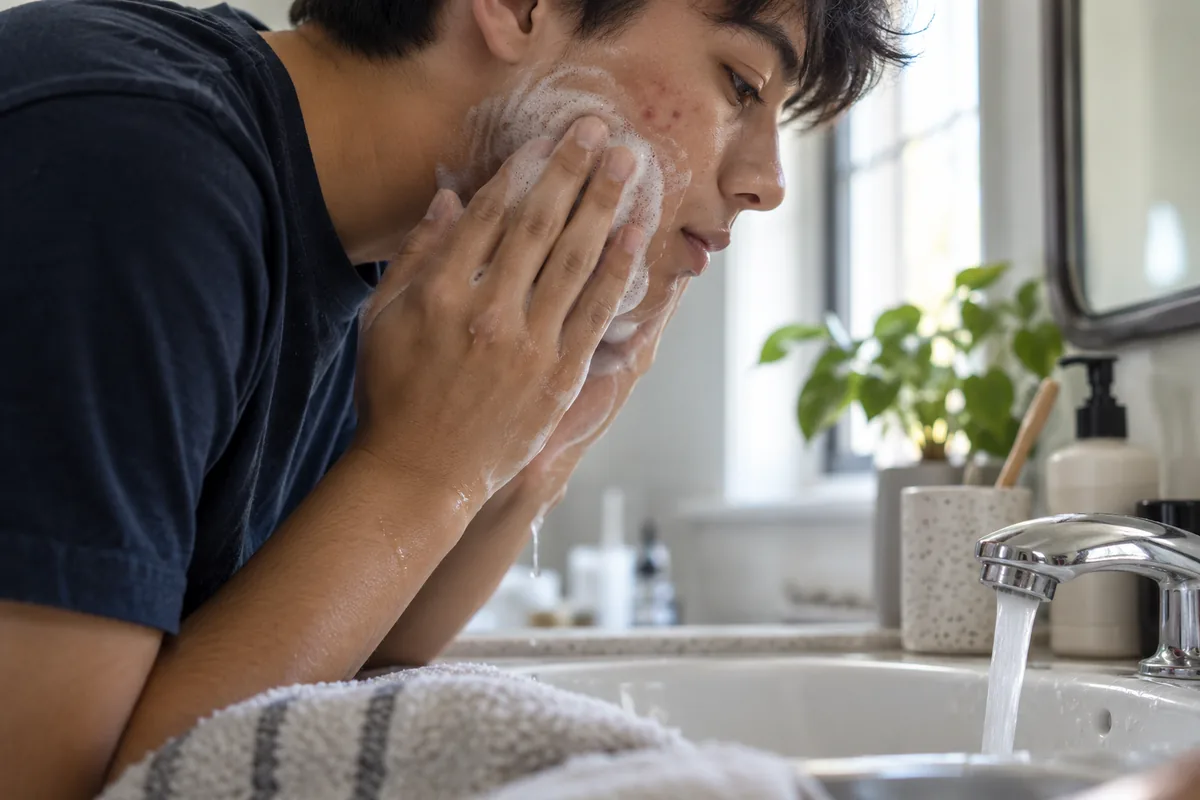
- Don't over-wash or scrub. Washing several times a day, or scrubbing, irritates skin that's already inflamed and can trigger more breakouts, not fewer [6]. A gentle cleanse morning and night, using hands or a soft cloth, is plenty.
- Don't layer on harsh products. Adapalene's label warns that combining it with abrasive cleansers, strongly drying products, or high-alcohol astringents needs caution, since dryness and stinging are already common on their own [4].
- Don't pick, pop, or squeeze. Doing so pushes what's inside a pimple deeper into the skin, increasing inflammation, and can introduce infection from bacteria on hands. The American Academy of Dermatology is blunt that this is how more-noticeable acne and permanent scars happen [7]. A pimple that genuinely needs extracting is a dermatologist's job, with sterile tools.
When it's time to see a dermatologist
Most teen acne responds to a consistent OTC routine within a couple of months. Some signs mean it's worth skipping straight to a dermatologist: deep, painful cysts or nodules; acne that hasn't budged despite a genuine OTC routine; and scars or dark marks showing up as it clears [8].
Just as legitimate a reason: feeling depressed or anxious, losing interest in seeing friends, or wanting to hide your face because of acne are explicitly listed by the AAD as reasons to seek treatment [8] — and the research backs that up. In a case-control study of adolescents with acne, teens with acne scored significantly higher on depression and anxiety measures than acne-free peers, were significantly more likely to report low self-esteem, and those scores tracked directly with worse quality-of-life scores [9]. None of that is something to tough out quietly. A dermatologist has prescription-strength options that aren't available over the counter — and treating the emotional side of acne isn't optional extra credit, it's part of treating it well.
FAQ
Can you use benzoyl peroxide and adapalene together?
Yes. Combining a retinoid like adapalene with benzoyl peroxide — as separate products or a combined gel — is a strongly-recommended approach in current guidelines, since the two work differently: one cuts bacteria, the other unclogs pores and calms inflammation [2].
Is it normal for skin to get dry, red, or flaky at first?
Yes. Dryness, scaling, and stinging are adapalene's most frequently reported side effects [4]. Starting a few nights a week instead of nightly, and following with a gentle moisturizer, usually helps skin adjust over a few weeks. If irritation is severe or isn't easing up, that's worth a conversation with a pharmacist or dermatologist rather than pushing through it.
Will teen acne just go away on its own?
Waiting has a real cost. Letting inflamed acne go untreated, or picking at it, raises the risk of permanent scarring [7], and acne itself is linked to real anxiety, depression, and low self-esteem in teens [9]. A simple routine now — or a dermatologist visit for anything cystic or scarring — tends to serve teens better than waiting for it to pass.