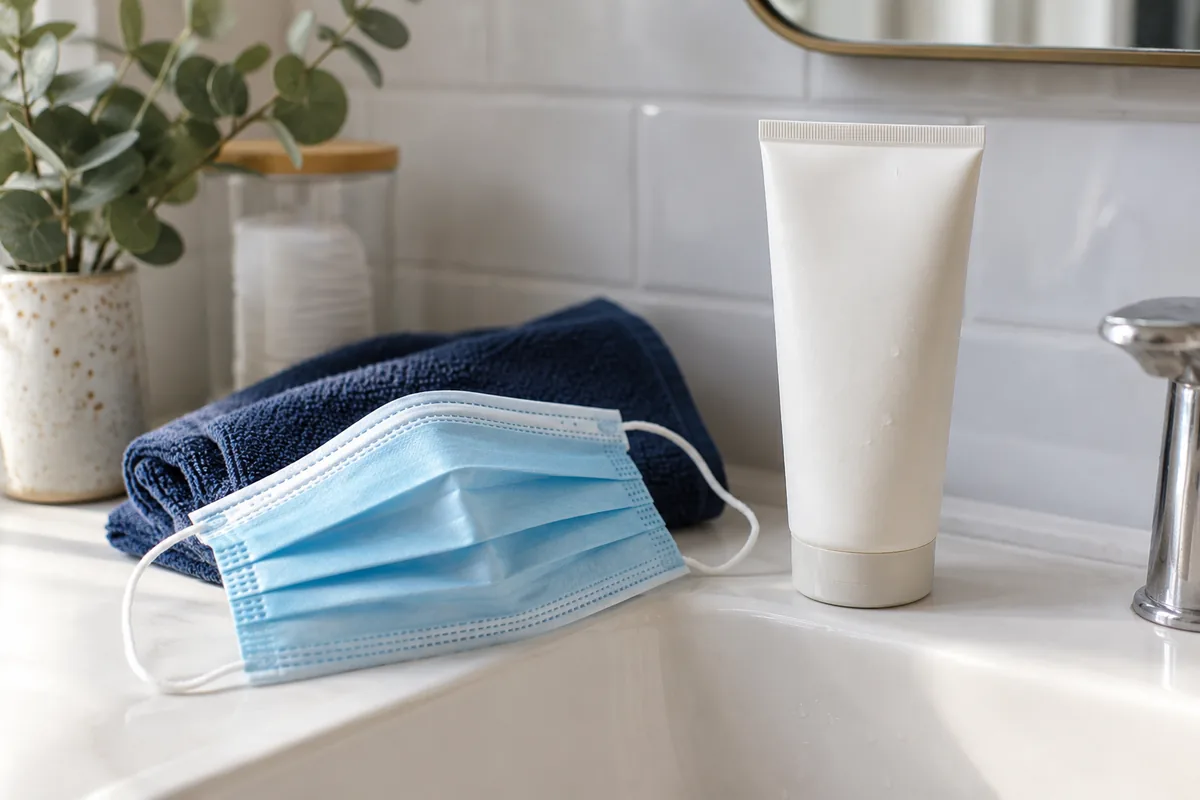
Why do I keep breaking out exactly where my mask sits?
Short answer: Yes, "maskne" is real. Hours of friction, trapped heat, and humidity under a mask change your skin's environment enough to trigger breakouts in a specific pattern — and pandemic-era studies measured it happening in real time.
What's actually happening under your mask
For hours at a stretch, a mask presses fabric against your skin, traps heat, and holds in moisture from your own breath and sweat. Dermatologists call this combination of pressure, friction, heat, and occlusion acne mechanica — a category that predates COVID-19 and was previously seen under chin straps and helmets, before getting renamed "maskne" once masks made it common [1].
A multi-center study that followed people wearing masks around eight hours a day during the first COVID-19 lockdown found this setup measurably changes the skin: masks trap moisture, raise oil output, and shift skin pH, conditions that favor the bacteria and mites already implicated in acne and rosacea flares [2]. Acne got significantly worse specifically on the cheeks, nose, and chin — the mask-covered area — while the forehead and upper back, which the mask doesn't touch, showed no change at all [2].
The Jeddah study (the 630-adult one above) adds the mechanical half: pressure and friction, combined with the heat and humidity trapped under a mask, make it easier for pores to get physically blocked [3]. DermNet's summary of protective equipment agrees that pressure and friction alone can flare acne mechanica, and that trapped heat which would normally escape as sweat evaporates adds to the effect, even without any bacterial contribution [5].
Maskne vs. everyday acne vs. perioral dermatitis
The biggest tell is location and timing: new acne within about six weeks of starting regular mask use, or existing acne getting noticeably worse, concentrated in what one review calls the "O-zone" — the mask-covered nose, mouth, chin, and cheeks — rather than the jawline or forehead patterns typical of hormonal or stress-related acne [1].
It's worth ruling out perioral dermatitis before you treat a breakout like acne, because the two look similar but respond to different things. Perioral dermatitis shows up as small bumps or pink, scaly patches around the mouth (sometimes the nose or eyes) that, unlike acne, never include blackheads or whiteheads, and it typically spares a thin strip of skin right at the border of the lips [4]. It has a strong link to topical corticosteroid use, and is also associated with heavy moisturizer-and-foundation combinations, physical sunscreens, and — like maskne — facemask use itself, so it's entirely possible to develop it from the same mask that's also giving you maskne [4]. Treatment differs, too: it responds to prescription antibiotics like metronidazole or clindamycin rather than benzoyl peroxide, and topical steroids should specifically be avoided — they calm it down temporarily, then it flares worse when you stop [4].
Mask hygiene and gentle treatment that actually works
Because the cause is mechanical and environmental as much as it's bacterial, prevention does a lot of the work. The American Academy of Dermatology recommends washing cloth masks after every wear and throwing away disposable ones after one use, since buildup on a used mask just gets pressed back into your skin next time [6]. A soft, breathable inner layer like cotton, a snug-but-not-tight fit, and a genuine break from the mask — around 15 minutes every four hours where it's safe — all cut down on friction and trapped humidity [6]. Skipping makeup under a mask, or sticking to fragrance-free, non-comedogenic products if you can't, also helps [6].
On treatment, resist the urge to throw your whole acne routine at it at once. The review that named maskne found that spot-treating with benzoyl peroxide, salicylic acid, sulfur, alpha-hydroxy acids, and retinoids makes skin more prone to irritation when it's sealed under a mask for hours [1]. That doesn't mean avoiding actives altogether — a well-formulated BHA exfoliant like salicylic acid still has a real place here. It just works better used on its own rather than layered with other actives, at a time of day when a mask isn't going straight back on top of it. Not sure what's in your current routine? Run the label through our scanner before you add anything new.
FAQ
Is maskne actually a different condition, or just acne with a trendy name?
It's a real, named subtype, not a rebrand. A 2021 clinical review classified it as a distinct variant of acne mechanica. A separate cross-sectional, self-reported survey of healthcare workers found 86% reported any skin change after mask requirements began; that percentage is not an incidence estimate and does not by itself prove mask-caused acne [1][7].
Can I keep using salicylic acid or retinoids if I wear a mask most of the day?
Usually yes, but ease in rather than layering everything at once — occluded skin is more prone to irritation from strong actives. Use a gentle BHA exfoliant on its own rather than stacking it with benzoyl peroxide or retinoids on the same day, and time it for stretches when a mask won't be pressed against your face right afterward [1].
How do I tell maskne apart from perioral dermatitis?
Check for blackheads or whiteheads, and look at the skin right around your lips. Maskne behaves like acne — comedones included — concentrated in the mask-covered zone, while perioral dermatitis produces small bumps without comedones and typically spares a thin strip of skin at the lip border [1][4].