How do you start a retinoid without your face peeling off?
Short answer: slowly. Prescription tretinoin has the deepest photoaging evidence, but that does not make every retinoid formula equivalent — and people quit most often by rushing the first month.
A "retinoid" is a family of vitamin-A ingredients. Prescription tretinoin has the strongest evidence for photoaging, including a particular clinical trial and biopsy studies [1][4]; those findings do not make the whole class a sure bet or prove that every retinoid or over-the-counter formula produces the same result. People often quit because they start like it's a race.
Think of the family as a ladder. Prescription tretinoin is the active form itself — the deepest evidence [1]. Over the counter, retinal (retinaldehyde) is one chemical step away from it, retinol is two steps, and retinyl esters are the gentlest and weakest. Your skin converts each toward the active form, and fewer steps means more strength but more sting. For a first retinoid, a 0.2–0.5% retinol or a low-strength retinal is plenty.
The starting plan:
- Two nights a week, because irritation adds up. The standard advice is to start every other night or slower and build only as your skin tolerates it [2]. There's no prize for nightly use in month one.
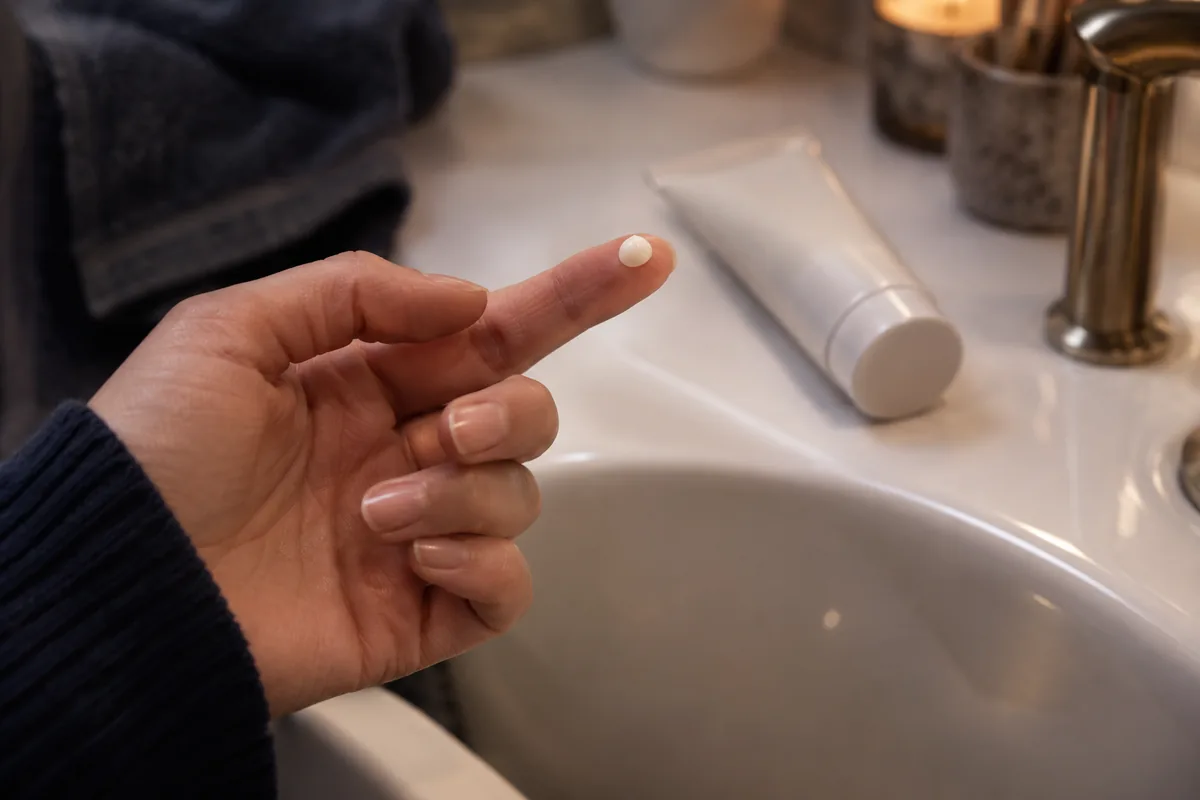
- A pea-sized amount for the whole face — more product doesn't do more, it just irritates.
- On fully dry skin. Let your skin fully air-dry after washing before applying — damp skin can absorb more product and sting more.
- Buffer freely. Moisturizer before or after softens the ride without weakening the retinoid — recent testing found that layering it on one side keeps the retinoid working [3].
What the first weeks should feel like: some dryness, light flaking, a little pink. This "retinization" peaks around week one or two and then settles. What it should not feel like is raw, cracked, burning, or itchy — that's your cue to pause, do a week of plain moisturizer, and restart less often. Backing off is the plan, not failure.
Two practical points: use daytime sun protection, and judge a product on the timeline supported by its own label or evidence. The classic tretinoin study was not a trial of the whole retinoid class, so do not treat it as proof that every retinoid or formula has the same three-to-six-month outcome [1].
Honest caveat: most of the deepest evidence is for prescription tretinoin, not the drugstore versions — your results depend on the formula and, mostly, on sticking with it. And if even the gentlest rung stays angry, bakuchiol matched 0.5% retinol in a 12-week head-to-head with less irritation, and is a reasonable detour [5].