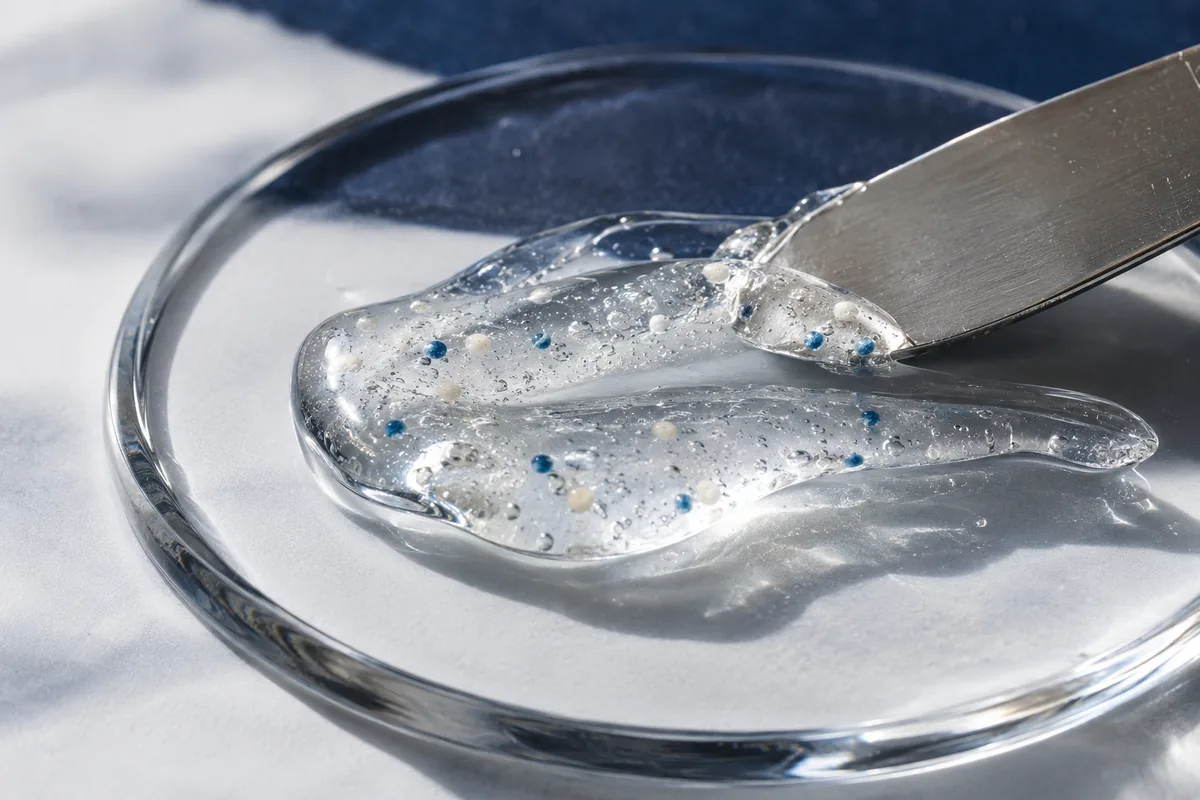
Are exfoliating microbeads actually banned in the US?
Short answer: yes, but narrowly. The Microbead-Free Waters Act of 2015 bans "intentionally-added plastic microbeads" only in "rinse-off cosmetics" — things you wash off, like face scrubs, body washes, and toothpaste. It says nothing about leave-on products, and it doesn't touch physical exfoliants that aren't plastic (walnut shell, sugar, jojoba wax esters). The federal ban has been in force since 2018, and most brands you'll find on a shelf today already comply.
What does the Microbead-Free Waters Act actually prohibit?
The law amends the Federal Food, Drug, and Cosmetic Act to make it illegal to manufacture or ship, in interstate commerce, "a rinse-off cosmetic that contains intentionally-added plastic microbeads." Reading the statute's own definitions: a "plastic microbead" is "any solid plastic particle that is less than five millimeters in size and is intended to be used to exfoliate or cleanse the human body," and "rinse-off cosmetic" is explicitly stated to include toothpaste [1]. Manufacturing had to stop by July 1, 2017, and selling existing stock had to stop by July 1, 2018 (with an extra year for products that are also over-the-counter drugs, like medicated acne washes) [1].
Two details in that text matter more than the headline "microbeads are banned":
- It only covers rinse-off products. A leave-on lotion, primer, or cream with plastic microspheres in it for texture or light-diffusing effect is not covered by the federal ban — that's a genuine, documented gap in the law, not an oversight people are misreading [1].
- It closed the "biodegradable plastic" loophole before it opened. Some state-level microbead bills that predated the federal law would have let manufacturers swap in "biodegradable" plastic beads instead — plastics that don't actually dissolve, just break into smaller fragments faster. Because the federal law defines "plastic microbead" by size and material rather than by an exemption for degradability, and preempts state laws that aren't identical to it, that loophole doesn't exist federally [1].
The law is short — two operative sections — and it was written to hit one specific product category (rinse-off exfoliating and cleansing products) rather than plastic in cosmetics broadly. If a term like "microplastics in skincare" is doing work in your head that includes glitter, encapsulated fragrance, or leave-on shimmer particles, that's outside what this statute regulates.
Why did the ban happen — was "8 trillion microbeads a day" a real number?
Not at the value everyone repeats, and it's a useful example of a number that traces to a real peer-reviewed paper and still doesn't check out. A 2015 paper in Environmental Science & Technology, using wastewater-treatment-plant data, did estimate how many microbeads enter U.S. aquatic habitats each day — but the widely-repeated "8 trillion" figure is the paper's own arithmetic error. The authors published a formal correction three months later fixing a transcription mistake that had inflated their numbers roughly 1,000-fold: the corrected estimate is about 8 billion microbeads entering U.S. aquatic habitats per day (roughly 2.9 trillion per year), with another roughly 800 billion per day — not 800 trillion — ending up in treatment-plant sludge that can also reach waterways through land application and runoff [2][3]. The corrected numbers are still a real quantity of plastic pollution; they're just three orders of magnitude smaller than the figure that stuck in headlines and, as far as we can find, was never walked back in coverage of the ban.
What the number describes, corrected or not, is entry into waterways, not beads reaching people or accumulating in seafood at a measured rate — headlines sometimes blur that distinction, and the original research doesn't claim it.
If plastic beads are mostly gone, what's actually in a modern "exfoliating" scrub?
Products still marketed as physical scrubs generally use non-plastic granules now: jojoba wax-ester beads, ground apricot or walnut shell, rice or oat powder, silica, or sugar and salt crystals. None of those are covered by, or need to comply with, the federal ban — they were never plastic to begin with — so their presence in a product doesn't signal anything about the 2015 law one way or the other.
Whether they're gentler than old-style polyethylene beads depends on particle shape, not just material: jagged shell or nut-fragment particles can still cause micro-abrasions if scrubbed hard, while smooth, round wax-ester beads are less likely to. That distinction — shape and how you use it, not "natural vs. plastic" — is closer to what dermatology sources actually flag as the mechanism of harm from scrubs: friction-based micro-tears and barrier disruption from uncontrolled abrasion, not the chemical identity of the granule.
How does chemical exfoliation compare, mechanistically, to a scrub?
A scrub removes dead skin cells by physically knocking them loose; an AHA or BHA dissolves the connections holding them together so they release on their own — a different mechanism, not just a gentler version of the same one.
AHAs (glycolic acid, lactic acid) are water-soluble. One well-documented mechanistic theory: AHAs degrade desmosomes — the "spot-weld" junctions between corneocytes — partly by chelating the calcium ions those junctions depend on, which loosens cell-to-cell adhesion and lets the outermost dead cells shed more evenly than friction does [4]. See our AHA exfoliant page for concentration and formulation specifics.
BHA — salicylic acid — works by a related but distinct route: it's classified as a desmolytic agent that extracts desmosomal proteins (including desmoglein) rather than dissolving keratin directly, and because it's lipophilic (oil-soluble), it's miscible with sebum and can travel into oil-clogged pores that a water-soluble AHA can't reach as effectively [5]. That review, from a single dermatology-department author with no declared conflicts of interest, is a widely cited mechanistic summary rather than a novel clinical trial — worth knowing since it's the kind of paper that gets cited a lot without readers checking what kind of evidence it actually is. See our BHA / salicylic acid page.
Direct head-to-head data on barrier disruption exists mainly for professional-strength treatments, not drugstore products: a split-face study in 14 women with acne, comparing a 40% pyruvic acid peel against the same peel plus microdermabrasion, found the combination (which adds physical abrasion) produced measurably higher gains in skin hydration and a larger drop in sebum than the acid alone — evidence that adding mechanical exfoliation on top of a chemical peel does something measurably different, not just a stronger version of the same effect [6]. That study didn't measure transepidermal water loss, so it doesn't speak directly to how fast either method disrupts the skin barrier — it measured hydration and sebum only. It was funded by a university with no manufacturer funding disclosed, and its sample size (14, all with acne) is small enough that it should be read as suggestive, not definitive, and specific to acne-prone skin rather than skin generally.
Is a physical scrub ever the better choice?
Sometimes, and the honest answer is that "chemical is gentler" is a generalization, not a rule that holds for every skin type. Oilier, more resilient skin often tolerates a mild physical scrub fine, and a plain washcloth is itself a form of physical exfoliation that dermatology sources generally treat as low-risk even for reactive skin [7]. The category to actually be cautious with — plastic or not — is anything with hard, jagged, unevenly-sized particles used with heavy hand pressure; that combination is what produces visible micro-abrasion, not the fact that a product is labeled "scrub" instead of "acid."
If you're checking what's actually in a product you already own rather than relying on front-of-package claims, our ingredient label scanner reads the real ingredient list.
FAQ
Does "microbead-free" on a label mean a product has zero plastic in it?
No — it specifically means the product doesn't contain plastic exfoliating/cleansing particles under five millimeters, the narrow category the federal law defines. It says nothing about a product's other ingredients, packaging, or whether it's a leave-on formula, which the law doesn't reach at all [1].
Are jojoba beads or ground shell scrubs required to say "microbead-free"?
No. The Microbead-Free Waters Act regulates plastic particles specifically; non-plastic exfoliating granules were never covered by it, so there's no compliance claim to make either way.
Is a chemical exfoliant automatically safer than a physical scrub?
Not automatically — both can cause irritation or barrier damage if overused, and the type of damage differs (chemical over-exfoliation shows up as stinging and dryness; mechanical over-exfoliation shows up more as visible abrasion). The mechanism is different, but "gentler" depends on concentration, particle shape, and how the product is actually used, not the category alone [6].