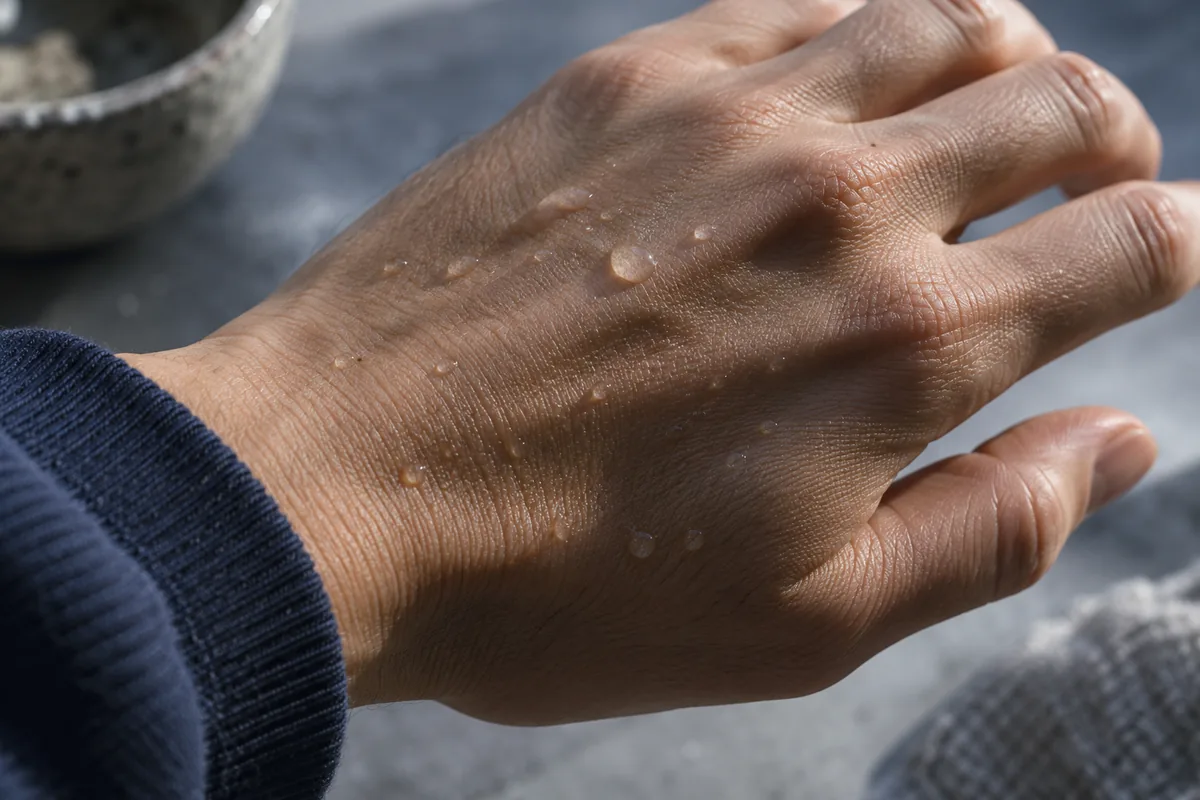
What is the "skin barrier," and why does everyone talk about it?
Short answer: it's one thin outer layer of cells and fats that keeps water in and irritants out — and it decides what your skin can tolerate.
Almost everything skincare argues about — dryness, sensitivity, stinging actives, "glow" — runs through one structure a fraction of a millimetre thick: the outermost skin barrier. Once you understand how it works, a lot of trial-and-error turns into cause-and-effect.
Bricks and mortar
As skin cells rise to the surface they flatten, lose their centers, and become corneocytes — the bricks. Between them sits a highly organized layer of fats — the mortar — made largely of ceramides, cholesterol, and free fatty acids [1][3]. That fatty mortar is the actual barrier: it's what water can't easily cross and what irritants can't easily get through. This is why "barrier" moisturizers lean on ceramides — they're replacing a fat the skin has run low on, not just adding grease; in one randomized trial, a specific ceramide-dominant cream and cleanser measurably restored the barrier over four weeks [4] — a trial funded by, and staffed with authors employed by, Ego Pharmaceuticals, the cream and cleanser's maker, so treat that specific result as suggestive company-sponsored data, not independent confirmation.
Water loss is the yardstick
Because the barrier's core job is holding water in, its health is measured by how much water escapes through it: transepidermal water loss, or TEWL [3]. Intact mortar means low water loss and comfortable skin; run-down mortar means high water loss and that tight, dry, reactive state where products start to sting. Ceramide-containing moisturizers measurably cut water loss — in one study, within hours of putting them on [2], a trial run by the same manufacturer as above, Ego Pharmaceuticals, on its own product — again real numbers, but not yet independently repeated.
The blend matters, not just one fat
A classic experiment compared specific mixtures of the three key fats and found different recovery results in an aged-skin model [1]. That supports studying the full lipid system, but it does not identify a universal ratio or prove that every "ceramide + cholesterol + fatty acid" formula beats every other moisturizer.
Natural moisturizing factor and filaggrin
Inside the corneocytes sits natural moisturizing factor (NMF) — a set of water-attracting molecules that hold water in the cells. A lot of it is produced when the protein filaggrin is broken down as cells mature [3]. When filaggrin is in short supply — as in many people with eczema — NMF drops, water loss rises, and skin is drier and more easily irritated [3]. It's a neat example of how one protein links genetics, dryness, and sensitivity.
What this means for a routine
Support the barrier by giving it what it's made of and not stripping what's there: humectants (glycerin, hyaluronic acid) to pull water in, barrier fats (ceramides) to hold it, gentle cleansing, and restraint with harsh actives [1][2]. When the barrier is already struggling — stinging, flaking, reactive — the fix is subtraction, laid out in barrier repair 101. Curious what's actually in a "barrier" product you own? Paste the label into our decoder to see whether it really contains the fats and humectants that do the work.
FAQ
What is transepidermal water loss (TEWL)?
TEWL is the amount of water that evaporates out through your skin. It's the standard lab measure of barrier function: a healthy, intact barrier keeps TEWL low, while a run-down or damaged barrier lets more water escape — which shows up as tight, dry, flaky, reactive skin. Barrier-supporting moisturizers are judged partly by how much they lower TEWL.
Are ceramides enough on their own?
Ceramides are a key barrier fat, but the mortar also contains cholesterol and free fatty acids. Specific experimental mixtures and tested products can support barrier outcomes; an ingredient list alone cannot establish a molar ratio or predict that a generic combination will outperform another moisturizer.