Why does my acne routine make my bumps worse?
Short answer: you might not have acne. Some "nourishing" products feed a yeast, and small, itchy, look-alike bumps clear on an antifungal — not on acne treatments.
The yeast behind fungal acne — Malassezia, a fungus that lives on essentially everyone's skin — feeds on specific oils and fatty acids [1]. That's the twist that trips people up. Many rich, "nourishing" moisturizers and oils, and even some acne products, are built from exactly the oils the yeast eats. So a routine that calms real acne can quietly feed a fungal one — which is why those small, itchy, same-size bumps shrug off benzoyl peroxide and retinoids and clear fast on an antifungal instead [1].
Why your acne routine can backfire. Malassezia is oil-loving — it thrives on oils and breaks fatty acids down for food using lipase (a fat-digesting enzyme), releasing irritating leftovers like oleic acid [1]. Plenty of well-meaning products hand it a buffet: heavy plant oils, oil-like esters, and some moisturizing ingredients that are perfectly good for dry or damaged skin. If your "hydrating, nourishing" routine is rich in those, and your follicles are prone to Malassezia, you can be treating your face beautifully and feeding the yeast at the same time. The bumps ignore benzoyl peroxide because bacteria were never the problem.
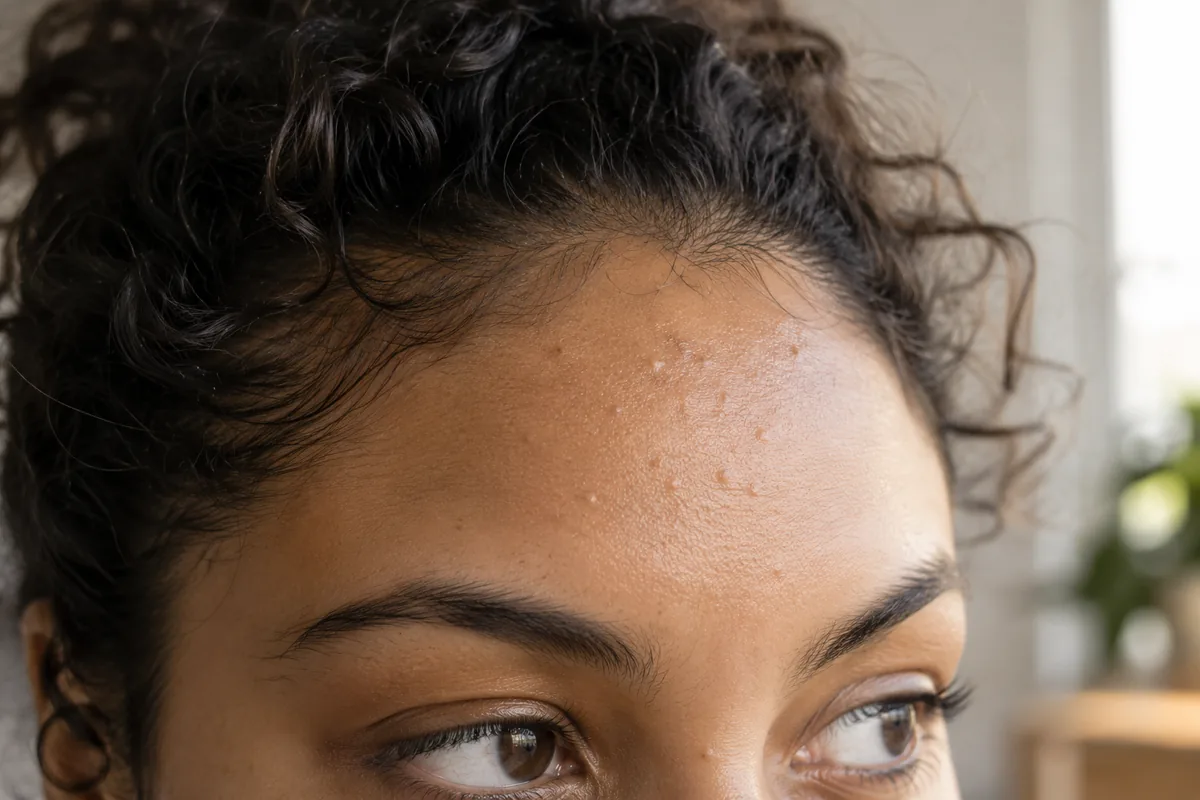
How to tell it apart from regular acne. Fungal acne has a look and a story. Appearance: small, boringly uniform bumps that are all about the same size — ordinary acne is a mix of blackheads, whiteheads, red bumps, and the occasional deep cyst. Feel: it often itches, which bacterial acne usually doesn't. Location: forehead, hairline, chest, back, and shoulders are classic. Triggers: it flares after heavy sweating, being covered up, humidity, and — tellingly — after a course of oral antibiotics, the kind sometimes prescribed for acne, because knocking back bacteria lets the yeast spread [2]. And the biggest tell of all: it doesn't clear on a good acne routine, but responds quickly to antifungals.
The ingredient-avoidance idea — with an honest caveat. The "fungal-acne-safe" trend is about starving the yeast: skipping many oils, fatty acids in a certain size range, and some oil-like ingredients (esters and polysorbates). The basic mechanism — Malassezia eats these oils — is well established, and free fatty acids like oleic and palmitic acid are the most consistently flagged food source [1][3]. But the risk isn't even across the whole list: esters and emulsifiers (glyceryl stearate, PEG-100 stearate, polysorbates, and the like) rest on weaker, more indirect evidence than free fatty acids do, so don't assume every ingredient the checker flags is equally risky. The specific "safe/unsafe" lists are shakier, more approximate science than the diagnosis and treatment overall. Concentration matters, individual triggers vary, and some flagged ingredients may be fine for a given person [3]. Treat the checker as a smart screen, not a verdict — it's most useful for spotting a heavy oil load in a product that isn't clearing your bumps. Paste an ingredient list into the fungal-acne checker to see which parts are known yeast food.
One label mix-up worth knowing: squalene isn't squalane. They're one letter apart and easy to confuse when scanning an ingredient list fast. Squalane (with an "a") is the stable, hydrogenated form and isn't a fungal-acne concern. Squalene (with an "e") oxidizes readily on skin, and the oxidized form has been shown to be comedogenic in animal-skin studies [7] — worth patch-testing if a label lists squalene rather than squalane.
What actually clears it. Antifungals, not acne ingredients. The off-label move people reach for is anti-dandruff washes containing zinc pyrithione, piroctone olamine, or climbazole — used on the affected areas as a quick wash you rinse off — because these are established antifungals against Malassezia: zinc pyrithione measurably lowers Malassezia levels on skin, and lab (in-vitro, concentration-dependent) testing has found piroctone olamine/climbazole combinations comparable to 2% ketoconazole against some Malassezia species, though not all [4][5]. That said, this is genuinely a see-a-professional situation: confirming it really is Malassezia folliculitis (and ruling out actual acne — or a bacterial infection — which changes everything) is what makes the treatment work, and stubborn cases sometimes need prescription antifungals. If the bumps are painful, warm, rapidly spreading, filled with pus, or paired with a fever, or a couple of weeks of a reasonable OTC antifungal approach hasn't helped at all, see a clinician rather than continuing to self-treat — it may be bacterial, not fungal [6]. Matching the fix to the cause beats the strongest acne routine when the cause is yeast.
A gentler routine while you sort it out. Simplify. Drop the heaviest oils and richest creams for now, keep cleansing gentle, and don't pile on new actives that add irritation without touching the yeast. Lightweight, fungal-acne-aware hydration — water-attracting ingredients (humectants) like glycerin rather than oil-heavy balms — keeps skin comfortable without feeding the overgrowth. Once things calm, reintroduce products one at a time and watch which ones bring the bumps back.
The bottom line. If uniform, itchy bumps are ignoring your acne routine — especially after sweating or antibiotics — consider that you might be feeding a fungal problem with a bacterial fix [2]. Screen your products for yeast food, switch to antifungal ingredients, keep the routine light, and get a diagnosis if it doesn't turn around quickly. For the fuller picture, see fungal acne isn't acne.
FAQ
How do I know if I have fungal acne or regular acne?
Fungal acne (Malassezia folliculitis) tends to show up as small, uniform, often itchy bumps on the forehead, chest, back, or shoulders, frequently worse after sweating or a course of antibiotics — and it doesn't respond to benzoyl peroxide or retinoids. Regular acne is a mix of sizes and types and usually isn't itchy. A clinician can confirm which you have, which matters because the treatments differ.
What ingredients feed fungal acne?
Malassezia feeds on many oils, fatty acids in a certain size range, and some oil-like esters and polysorbates. That's the basis of "fungal-acne-safe" formulating. The mechanism is well established, but the specific ingredient lists are approximate — concentration and individual response vary — so use a checker as a screen rather than an absolute rule.
What actually treats fungal acne?
Antifungals, not acne ingredients. People commonly use anti-dandruff products containing zinc pyrithione, piroctone olamine, or climbazole on the affected areas, since these are established antifungals against Malassezia — though much of the head-to-head evidence for these OTC actives is lab-based and concentration-dependent rather than large human trials. Because confirming the diagnosis — and ruling out true acne or a bacterial infection — is what makes treatment work, and stubborn cases can need prescription antifungals, it's worth seeing a professional, especially if bumps are painful, spreading, or feverish, or don't improve within a couple of weeks.