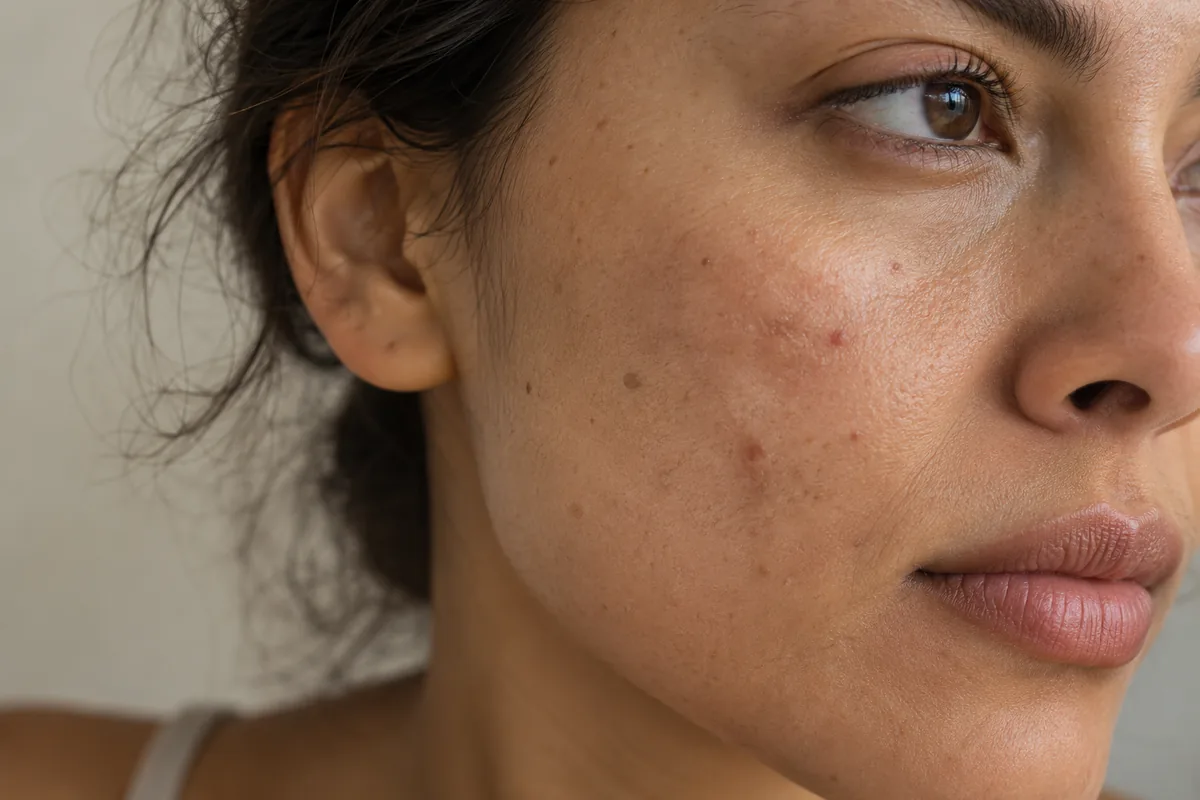
Are your leftover acne marks red or brown?
Short answer: it matters enormously — red marks and brown marks are different problems, and most "dark spot" advice only fixes the brown ones.
The pimple heals but leaves a mark. What you do next hinges on one thing you can see in the mirror: is it red-to-pink or brown-to-gray?
Red marks are PIE — post-inflammatory erythema, a fancy name for leftover redness. The old pimple's inflammation dilated and damaged tiny blood vessels underneath, so what you see is blood flow, not pigment. Dermatologists only coined the term in 2013, precisely because these marks kept getting mistaken for pigmentation and treated as if melanin (skin's brown pigment) were the problem [1]. Quick test: press a fingertip or a glass on the mark. PIE fades while you press — you're squeezing the blood out — while a brown mark doesn't.
Brown marks are PIH — post-inflammatory hyperpigmentation. Here the inflammation kicked your pigment cells into overdrive, leaving extra melanin behind. It's more common, darker, and longer-lasting in deeper skin tones, where it's often more upsetting than the acne was [2].
Why the color decides everything: the whole "brightening" aisle — vitamin C, arbutin, kojic acid, tranexamic acid, azelaic acid — works by reducing melanin. Point that at brown PIH and you're hitting the real target. Point it at red PIE and there's no extra pigment to reduce, so months of serum do nothing and the product gets blamed.
- For red PIE: time is the main fix — the vessels calm down over weeks to months. Sun protection helps, and not picking keeps each mark from being re-injured. Pulsed-dye laser has been described in anecdotal case reports, but the cited PIE paper does not provide comparative treatment evidence [1]. No serum reliably beats time here.
- For brown PIH: daily broad-spectrum sunscreen is the non-negotiable base — UV re-fires the pigment you're fading, so it's what lets any treatment hold its gains [2]. Add azelaic acid (gentle, kind to deeper tones), the brightening serums above, and a retinoid to speed turnover; for deeper tones, a tinted sunscreen adds visible-light protection plain SPF misses [3]. Expect months, not weeks — surface pigment fades over a season, deeper pigment slower [2].
One trap both share: be gentle. In mark-prone skin, fresh irritation creates new marks, so harsh scrubs and strong peels can grow the very problem you're treating. And treating the acne itself is the biggest win — every pimple you prevent is a mark you never get.
Honest caveat: this is pattern-matching, not a lab test. If marks haven't budged after four to six months of sunscreen and a pigment routine, or red marks really bother you, see a dermatologist — they can confirm which one you have and offer prescription and laser options for both.