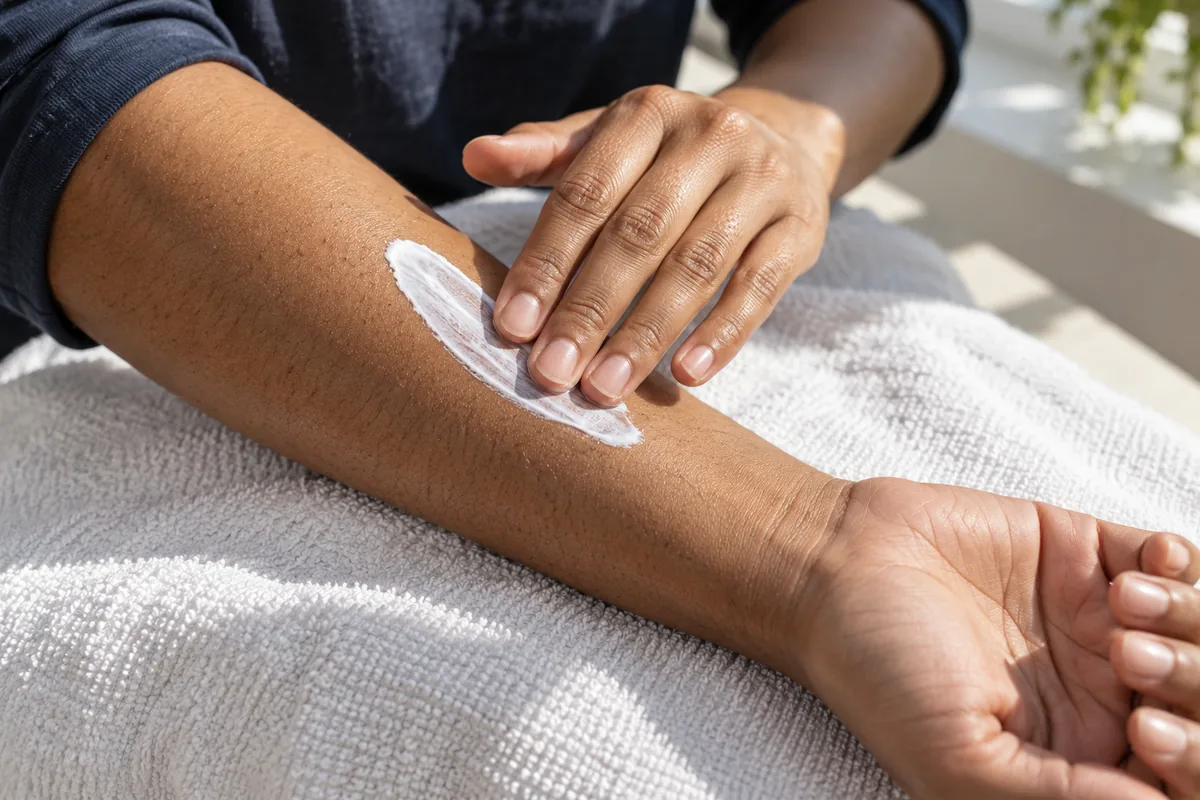
How much sunscreen do you actually need to put on?
Short answer: about a teaspoon for your face and a shot glass for your body — roughly double what most people use, which is why real-world protection usually falls short of the number on the label.
Sunscreen is the single most proven anti-aging, anti-cancer step in skincare — and the one people most reliably underdo: not by skipping it, but by using too little, missing spots, and not reapplying. None of that shows on the bottle, so it's easy to assume you're getting the SPF on the front when you're not.
Why your SPF 50 isn't giving you SPF 50
The number on a sunscreen bottle comes from a lab test done at a specific, generous thickness — 2 milligrams of product per square centimeter of skin, the internationally agreed standard that SPF 30 or SPF 50 is actually measured at [5][6]. In bathroom-sink terms, that's about a teaspoon for your face and a shot glass for the rest of your body [1].
Almost nobody applies that much — the AAD says most people use only 25–50% of the recommended amount [2], and a widely cited BMJ analysis measured real-world application at 0.5–1.5 mg/cm², well under the tested dose, estimating that under-application cuts effective protection to roughly a third of the labeled SPF [6]. That's the honest answer to "isn't SPF 30 basically the same as SPF 50?" — on paper that jump blocks a modest extra sliver of UV, but because under-application is nearly universal, a higher number mostly buys margin for the sunscreen you'll actually apply, not perfection. (More sunscreen myths, checked against the evidence, here.)
Reapplication: the two-hour rule
Reapply every two hours outdoors, and right after swimming, sweating, or toweling off [3][4] — filters break down and rub off in that window no matter how carefully you applied, which is exactly why labels can't legally promise longer [4].
Water resistant doesn't mean waterproof — no sunscreen is. Products are tested and labeled for either 40 or 80 minutes of swimming or sweating before you need to reapply — not a pass for the rest of the day [3][4].
Reading the label: SPF, broad spectrum, and PA
Two numbers do two different jobs. SPF measures protection against UVB, the shorter wavelengths mainly responsible for sunburn [3]. Broad spectrum means a product also meaningfully blocks UVA, the longer wavelengths behind skin aging — only products that pass the FDA's broad-spectrum test can use that label [3]. PA, common on Korean and Japanese sunscreens, grades UVA protection on its own four-step scale instead: PA+ is a UVA protection factor of 2 to under 4, PA++ is 4 to under 8, PA+++ is 8 to under 16, and PA++++ is 16 or higher [7]. More pluses means more measured UVA protection, not a marketing flourish.
Whichever system a sunscreen uses, the ingredient list matters more than the badge on the front — a mineral filter like zinc oxide and a well-formulated chemical filter can both deliver real broad-spectrum coverage. Our label scanner pulls out the actives if you'd rather not decode a label yourself; the fuller mineral-versus-chemical breakdown is here.
The spots — and the step — people skip
Even people who apply enough sunscreen miss the same spots. The FDA's list of frequently forgotten ones: ears, nose, lips, the back of the neck, hands, tops of feet, the hairline, and any exposed scalp [3]. Lips need their own coverage — an SPF lip balm, not face sunscreen dabbed on with a fingertip [1].
Sunscreen also has a specific place in your routine, and it's not first: cleanse, treat, moisturize, sunscreen last, right before makeup [8]. Don't count on layered SPF to add up, either — an SPF 30 moisturizer plus SPF 30 foundation doesn't equal SPF 60; each product's SPF is measured on its own, and stacking adds some real protection, but not by simple addition [9].
FAQ
Do I need "real" sunscreen if my moisturizer or makeup already has SPF?
Usually, yes. Dedicated sunscreen is formulated and tested for the full teaspoon amount; moisturizer and makeup with SPF are rarely applied that generously, and stacking two under-applied SPF products doesn't add up to their combined number [6][9]. Treat SPF makeup as a bonus layer, not a replacement for real sunscreen.
Is SPF 50 worth buying if I know I won't apply the full amount?
Probably yes — that's exactly the situation a higher number helps with. Since most people apply only 25–50% of the tested amount, effective protection lands well below the label regardless of which SPF you buy [2][6]. Starting from SPF 50 instead of SPF 30 gives you more room before under-application drops you into unprotected territory.
Does a higher SPF mean I can reapply less often?
No. SPF and reapplication timing are separate questions — a higher number doesn't buy extra hours before filters break down. Reapply every two hours outdoors, and right after swimming or heavy sweating, regardless of the SPF on the bottle [3][4].