Do you actually need to double cleanse?
Short answer: only if you're wearing water-resistant sunscreen or long-wear makeup. That's the one thing testing backs — the rest is ritual.
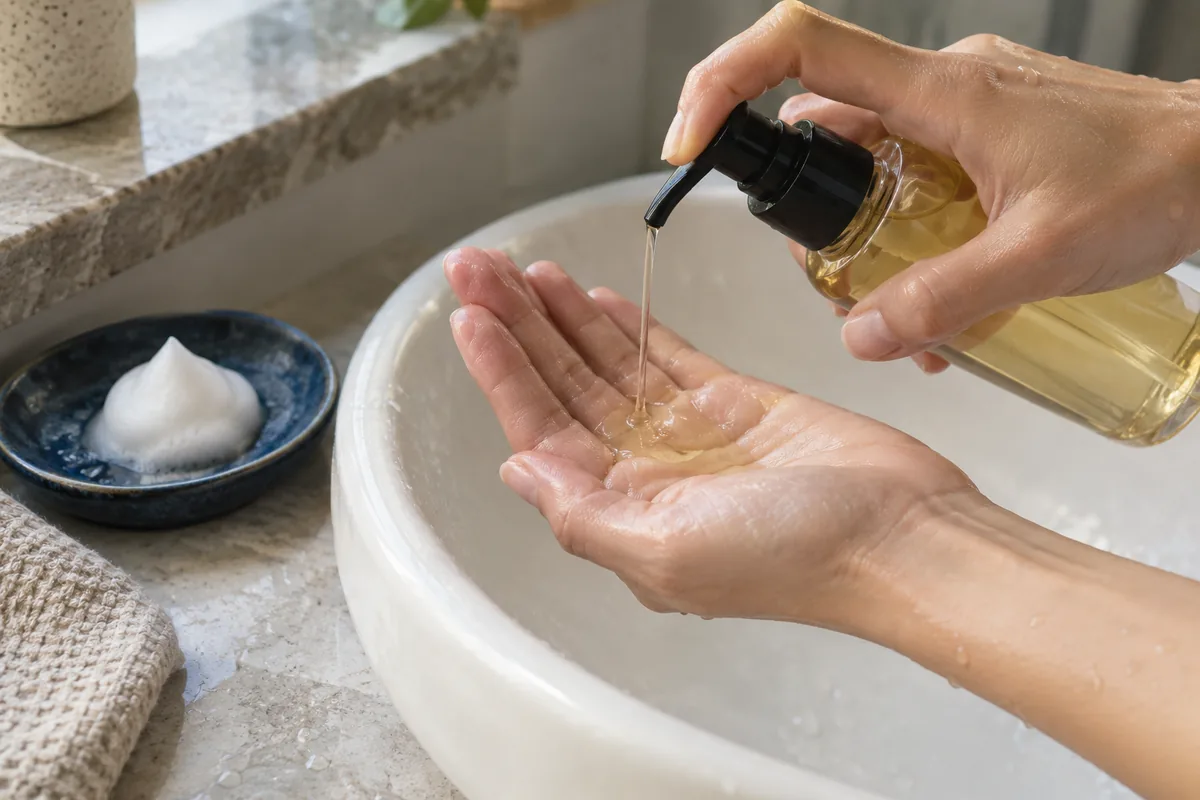
"Double cleansing" is the K-beauty two-step: first an oil or balm cleanser massaged onto dry skin to dissolve oily grime — sunscreen, sebum (skin's natural oil), makeup — then a water-based gel or foam cleanser to lift away the rest. The logic is real chemistry: oil dissolves oil, and plain water-based cleansers struggle with the water-resistant, film-forming ingredients modern sunscreens use to stay put [1]. If your sunscreen uses the mineral filters zinc oxide or titanium dioxide, the same question applies — what resists rinsing is the water-resistant, film-forming base the filters sit in [1].
Here's the actual evidence. In a controlled test on 20 volunteers, an ordinary water-based cleanser removed non-water-resistant sunscreen, while the tested water-resistant sunscreen formulation was removed more effectively with a cleansing oil [1]. That study does not establish a rule for long-wear makeup, every sunscreen, or all cleansing routines. Everything else attached to the ritual — that it "detoxes," "deep cleans," or is mandatory every night — is convention, not evidence.
And cleansing isn't free. Wash too much and you can strip the ceramides and lipids that hold the barrier together — that tight, reactive, over-cleansed feeling. The type matters too: gentle synthetic-detergent (syndet) cleansers are less harsh on skin proteins than traditional alkaline soaps [2]. Two washes when one would do — especially with a foaming cleanser and hot water — is a common way people damage a barrier that was fine.
So when does the oil step earn its place?
- At night, if you wore a water-resistant sunscreen like the formulation studied — an oil or balm cleanser may earn its place [1]. The study does not directly establish the same result for long-wear makeup or every cleansing oil.
- After a heavy-SPF day — beach, sport, lots of reapplication — the oil step does real work.
And when is it just ritual?
- In the morning — you slept on clean skin; there's no sunscreen or makeup to dissolve. Water or one gentle cleanse is plenty.
- On a bare-face day — no SPF, no makeup, nothing to double up on.
Think of double cleansing as a removal tool matched to a removal problem, not a virtue you owe your skin. Wearing a water-resistant sunscreen you love? The oil step is how you take it off cleanly at night — not sure if yours qualifies? Check the label with a label decoder. Not wearing much? One gentle cleanse, and keep both steps mild so you don't strip a barrier that was doing fine [2][3].
Honest caveat: the evidence here is essentially one small 20-person removal study [1]. It's a clean result for the narrow question it asked — getting water-resistant SPF off — but it says nothing about "detoxing" or long-term skin benefits, because those were never the claim.